This was a house of piano keys. The clocks kept fairy tale time, dinner was a guess, no one wore pockets. I wove a nest of straw, placed inside it a brother’s curl, which one? buttons from a midden, scraps of paper where I wrote my name in ash, charcoal, blood.
My new husband said leave it, it’s worthless. Why buttons, here’s beads, that’s not your name anymore; a house of straw will always blow down. But I hoarded the treasure; stored it in a crevice I carved into a Bible, hid it in the attic against judgement day.
…
Linda McKenna’s debut poetry collection, In the Museum of Misremembered Things, was published by Doire Press in 2020. She has had poems published in a variety of publications including, Poetry Ireland Review, Banshee, The North, The Honest Ulsterman, Crannóg.
When I look back, I see a multi-million pound Formula One pit-crew, making snap decisions at break-neck speed, but instead of shaving seconds off, their goal is to add precious time onto precious lives— underpaid NHS nurses and midwives rush around the motionless bodies of my wife and new-born child, their engines barely ticking over, me, an open-mouthed spectator, but today there will be no final lap or chequered flag, as light reappears in my wife’s eyes, and our son’s first cries fill the room. Our race goes on and just like that our pit-crew has gone, leaving us to celebrate upon our podium with rounds of buttery toast and hot cups of tea.
…
Niall M Oliver lives in Ireland, and is the author of ‘My Boss’ by Hedgehog Poetry. His poems have featured in Acumen, Atrium, The Honest Ulsterman, Fly On The Wall Press, Ink Sweat & Tears and others. Twitter @NMOliverPoetry
Laura Varnam is a Lecturer in English Literature at University College, Oxford. Her work is inspired by the medieval poetry that she teaches. She has poems published in Ink, Sweat & Tears, The Oxford Magazine, Green Ink Poetry and forthcoming in Dreich. Twitter: @lauravarnam
Falling in love with a second PE teacher was reckless
…
Galia is a British-Israeli writer, musician and crafter, who works full time as Head of English, media and film at a secondary school in North London. She has lectured at the Shakespeare Institute, the British Library and is on the committee for the London Association for the Teaching of English. Follow her on Twitter @galiamelon
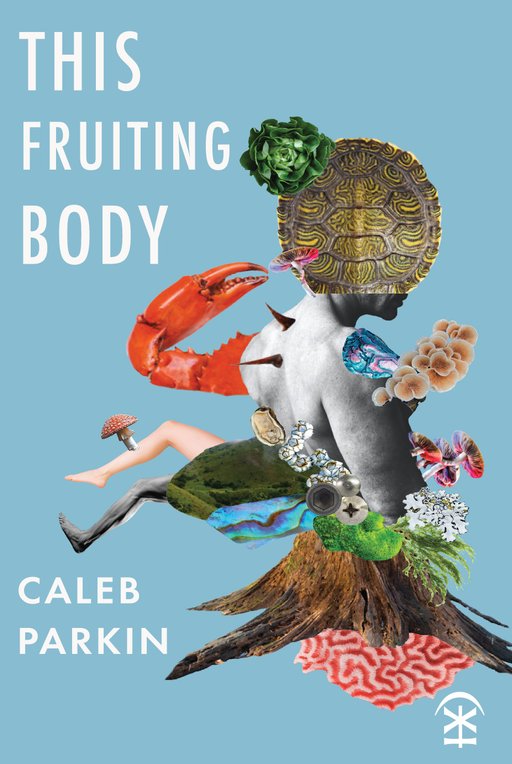
Our featured publication for November is This Fruiting Body by Caleb Parkin, published by Nine Arches Press.
Caleb Parkin’s debut poetry collection, This Fruiting Body, plunges us into octopus raves and Sega Megadrive oceans, in the company of Saab hermit crabs and ASDA pride gnomes. It’s a playful invitation to a queer ecopoetics that permeates our bodies and speech, our gardens, homes, and city suburbs. It reintroduces us to a Nature we’ve dragged up until it’s unrecognisable.
“This Fruiting Body is an exhilarating book that fractures categories by showing the reader what thrives beyond the prison of the human self. The queer filaments between its poems form a compassionate brocade that holds together all living creatures, the dreams of ants and mould allowed to ‘billow and spore’ alongside deep-fried skyscrapers and ASDA pride gnomes. The stakes are urgent, the days ‘trembling like antennae’ but let’s think like a dung beetle, one poem whispers, and ‘roll the sun together’. Generous, monstrous and inspiring.” John McCullough
“Unwriting and rewriting our myths of ‘nature’, This Fruiting Body is a thrilling collection of queer love songs for the earth. Parkin’s femme earth mother may be on an IV drip, but she wears her artifice with joy and audacity: this is mother earth, drag queen of the universe, a body aching from harm but still devoted to pleasure. Parkin’s poems are infinitely lavish and full of wit, morphing human and more-than-human bodies in a post-human lyric disco lit with ecological thought. I felt better and wetter after reading it: more open to the press of language, life, and the strangeness of the earth.”Samantha Walton
garden
…
All the chipshops I have ever been to
are stacked up, a deep-fried skyscraper, somewhere on the East Anglian coast. This tower of bubbling fat concealed beyond Clacton-on-Sea, Walton-on-the-Naze, casts shadows near the shibboleth of Aldeburgh.
In the blue-black-grey around Cromer’s ingrown pier, an undrownable orange buoy invites me in, to swim.
Still, enveloped food shifts across their miles of steel counter, papers shaken through with white plastic bollards of salt. The North Sea lingering in flesh, mushy peas copied and pasted until no longer green.
Meanwhile, Sizewell B is a puffball on the horizon, domed as a worm moon rising, eye with no iris.
In the steaming museum cases of the tower’s counters,# the crispy sarcophagi of battered sausages, preserved remains of Cod: body after body, dredged up in silver cages; hundreds of Pukka Pies in their capsized foil crowns.
At Dunwich Heath, the oyster-catchers are on strike, curlews are threatening to straighten their beaks.
The tower wavers like seaweed, shimmers – a candle, its unknown postcode defined by the scent of second-hand oil, slicked through wardrobes. Chips in the toes of socks, fishbones catching at collars.
In each of those chipshops, the radio plays the creak of a sign, rush of a wave – then static.
…
After the Section 14
‘Police have banned Extinction Rebellion protests from continuing anywhere in London, as they moved in almost without warning to clear protesters who remained at the movement’s camp in Trafalgar Square.’ – The Guardian, October 15th 2019
The morning after the news, I pass Oxford Circus where giant screens order me to Taste the feeling, but when I arrive at Trafalgar Square, all I can taste is the bitter aftermath of extortionate coffee.
All I can taste is regurgitated water, rushing from the beaks of these dolphins, chins restrained by metal hands. All I can taste is the feeling that these tourists are grey ghosts, that I am a ghost, on this stone grid. All I can taste is the sickly mess
in the jaws of bin-raiding wasps. The lights on police vans flashing like migraines. The sign keeps demanding, in thousands of diodes and fast-cut swirly edits to Taste the fucking feeling. But all I can taste are inedible scraps pecked at by pigeons.
All I can taste are three police overseeing one flip-flopped man. Then, megaphones descend from the gritted teeth of the National Gallery; the lasso of high-vis tightens, each jacket clutches their own hands, formal, blank-faced; eyes flit and ears await
instruction from elsewhere. By the rented Thames, Big Ben reveals its new face – features rusted, commanding. We crowd in and nearby a cracked voice demands: Are you affiliated? Then again: Are you affiliated? It’s a simple question. A simple question.
…
Caleb Parkin is the third Bristol City Poet. He won second prize in the National Poetry Competition 2016 and the Winchester Poetry Prize 2017. Poems in The Poetry Review, Poetry Wales, The Rialto, Under the Radar, Butcher’s Dog and Molly Bloom. Wasted Rainbow (tall-lighthouse, Feb 2021). This Fruiting Body (Nine Arches, October 14th ). Tweet: @CalebParkin
This Fruiting Body is available to purchase from the Nine Arches Press website.
When Clapham Rick stayed with us for a week we hid our little silver knick-knacks, those which could fall into pockets unmissed until some days later when a lack of dust would cough their absence from the mantelpiece. We felt rotten – as if we’d breached his trust. He said he’d dumped the junk and kicked the horse, was clean as snow but for the booze, of course.
He said our farmhouse with its bird-pulled thatch made him feel uncomfortable, spooked by bats outside the window, the only night sound the scrabble of house mice. He couldn’t rest without a traffic lullaby to drown out the darkness. It was probably best he didn’t come to stay in January – when vixens scream like injured babies.
…
Devon based poet and musician Marc Woodward’s recent collections include Hide Songs (Green Bottle 2018) and The Tin Lodes – co-written with Andy Brown (Indigo Dreams 2020). His new collection Shaking The Persimmon Tree will be published by Sea Crow Press in April 2022. Find more at: www.marcwoodwardpoetry.blogspot.com and www.facebook.com/marcwoodwardartist and @marcomando
Waits for the day Of reckoning Snap after snap Blanket on cheese And ham You will never Get to the core Of the problem By peeling away layers It will reveal itself When you least expect Throw away plastic & crunch the stub
..
Nora Blascsok is a Hungarian poet based in the UK. Her work has appeared in a variety of online and print publications. A selection of her poems titled ‘Headspace’ is out with Broken Sleep Books imprint Legitimate Snack in September 2021.
I am a stupid prawn except I am not really stupid but neither am I really hot you know the kind of hot that makes you want to smash your toes with a hammerhead shark on purpose
or makes you want to swallow banyan trees until your intestines say proceed with caution, please! I am a prawn without a tail I cannot swim I drown in piles of hemp seeds I am prawn
with fire brown eyes and dodo brain I break umbrellas inside man-grottos smelling cigarettes and Tom Ford I cannot afford my own habits doesn’t that seem a bit ironic? I hate on David Foster Wallace
gleefully I fill ears with shit-hot discourse that tastes like purring overnight oats soaked in acacia honey and blueberries so it is slightly inedible but looks good from afar maybe 30 feet away
close friends forget to text me back but maybe the problem isn’t me! maybe the problem is that my prawn is overwhelmingly prawn maybe the problem is that I always carry a canvas bag full of stinky dxy orbitals
that want to choke throats and throw tantrums in uncomfortable situations maybe the issue is that I am missing a z-axis which meanders into brains to find out exactly what people think of me neurotic a solid 7 hairy ugh her again
I am not the ultimate task master I cannot compete with time my clock visits me in my sleep red-pecking at heart like a neanderthal and I wake with psoriatic itch I am prawn dreadfully in love but mostly toopuss to navigate
through it maybe the problem is that hopelessness is brothers with pity and I have not acknowledged it because maybe I am also hopeless prawn I am wasteman prawn I eat 55 gsm paper for snacks and die every night repeatedly
…
Sidrah Zubair is a poet and English teacher living and working in London. She has previously been published in PERVERSE, bath magg and Poetry Birmingham Literary Journal among others.
Patience, eyas. The wind is not yet awake. Wait for its breath to rise and turn
till you can scoop the air under pointed wing.
Your eyes are not windows, but walls. Enamelled with anger,
watchful, siege-ready; mistrust kept safe behind ashlar and buttress.
Although the frosts snap at your feather buds the spathes will grow curved and strong.
When the barbs lock firm to collar the wind then, eyas, we’ll be ready to begin.
…
Eyas: a young hawk, especially (in falconry) an unfledged nestling taken from the nest for training
…
Currently living in Hertfordshire, UK, Anna Milan’s poems have appeared in publications such as Under the Radar, Eye Flash Poetry, Black Bough Poetry and Ink Sweat & Tears. @annamilanwrites
and it seemed each wish, every desire I had to see you go, had stitched a feather one after another upon your back. First black and lustrous, then foxing, like the tidal stain on my finger from your silver ring.
You flew
far above the horizon, far above every other animal and its stretched out twin, blackened like bonfires. You watched the land beneath you pass, a plead in greens; the sun (a rare sight for you) flash-lighting musical notes on every pond, puddle, muddy muddled lane between us.
You landed
and I pictured you, with her, stretching. Shaking me out of your limbs, your wings. Loose as a doll whose elastic snapped. Her face is a plastic supplication, a painted tight beak.
You shook
and I heard about the quake. I felt it, watched it on the morning news, called the presenter a liar. My teacup shivered its saucer in my hands and the memories pink ringed my cheeks.
For a moment on the screen, I thought I could see the yellow of your eye.
I wondered then
after all of this shuddering of us, did the arrow I left in your side still quiver?
…
Jennie E. Owen’s writing has won competitions and has been widely published online, in literary journals and anthologies. She teaches Creative Writing for The Open University and lives in Lancashire with her husband and three children.


 atriumpoetry.com