Featured Publication – Making Tracks by Katy Wareham Morris

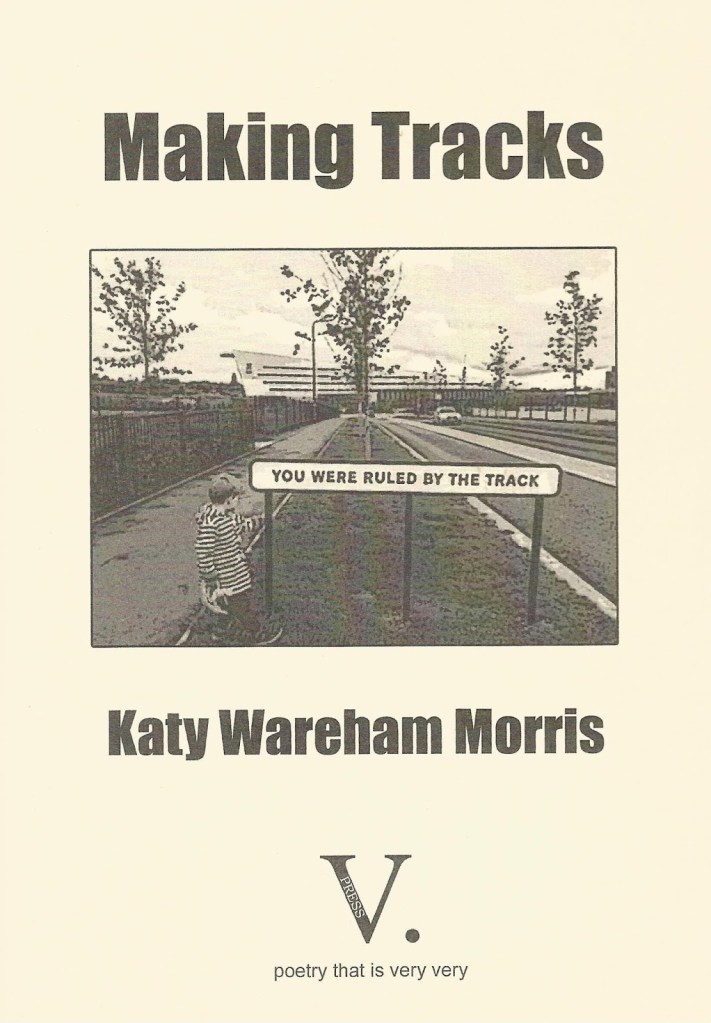
Our featured publication for October is Making Tracks by Katy Wareham Morris, published by V. Press.

From the very first page of this pamphlet, the reader encounters a voice which is entirely new. Within this pamphlet we find interrogations of masculinity, class, manual labour, what is and isn’t inherited through different generations and, most excitingly, see how these different preoccupations can be refracted and reflected through language and the line. As there should be when searching for new ways to contemplate tradition, a fresh type of experimentation with language, its spacial arrangement and its breath, is given to the reader, but always with a solid and concrete centre of people and place. A balance is struck between the heart, and the search for a language, scientific or natural, which might be able to fully represent it. Poems such as ‘You and Him: A Venn Diagram’ give us a visual language for exploring the pamphlet’s themes, and the pamphlet as a whole brings together the insertion of the urban and natural, the historical and the contemporary. An exciting new pamphlet from a poet doing important new things with the art.‘ Andrew McMillan

Making Tracks uses the texture of language and collaged fragments to celebrate those people who worked at the now defunct Longbridge car factory.  Wareham Morris’s father is the beating heart at the centre of these poems, it’s whose voice we hear, entrusted to her tender keeping.  There is the melancholy of a way of life gone here, but also the love of a day’s work and the satisfaction of a job well done.‘ Helen Ivory
The Heart

St Modwen: “What we are doing is putting the heart back into
Longbridge.

  1. Attractive developments in stunning park-side locations
    for first-time buyers, young families and downsizers
  1. creating inclusive, friendly environments evolving day
    by day
  1. with nearly 100 businesses currently located creating
    3,700 jobs across a variety of sectors since 2007
  1. utilising old industry and new technology, this is a
    unique £300 million project
  1. securing the best training for young people and adults
    with high quality educational establishments
  1. and a flagship youth centre called ‘The Factory’
    offering innovative and creative activities
  1. on a stunning three-acre urban park with free parking
    available for up to three hours
  1. building communities, using the rich heritage while
    looking to the future

9. a stronger, more prosperous

10. place to call home

I say to the kids, whilst we eat our Marks’ sandwich, “This is
where Grandad used to build cars.”

Vehicle Scheduling (Fragment V)

as shells came out of the paint shop painted we’d put the order
on send to the track for trim as shells came out of the paint shop
painted we’d put the order on send to the track for trim stop

for tea walk to the urn fill the pot walk back get the sarnies out
cars come down from the roof no cars to the track cars come
down from the roof no cars to the track track runs out there
ain’t no cars

5 trim tracks 2 copies on the order take 1 copy off send to the
conveyor keep the copy in order of bodies right order right
engine right shell 5 trim tracks 2 copies on the order take 1 copy
off send to the conveyor keep the copy in order of bodies right
order right engine right shell here comes the engine here comes
the body stop

this should be an automatic he got them arse about face bastard
eating sandwiches drinking a pint as shells came out of the
paint shop painted we’d put the order on 5 trim tracks 2 copies
on the order take 1 copy off send to the conveyor send to the
track for trim keep the copy in order of bodies right order right
engine eating sandwiches drinking a pint as shells came out of
the paint shop painted we’d put the order on 5 trim tracks 2
copies on the order take 1 copy off send to the conveyor send
to the track for trim keep the copy in order of bodies right
order right engine stop

dispute meeting ain’t solved it (planned it?) right we’re off

Terrible Really

They were bloodying fists all the time,
you kept your cool, though your heart was
still beating all the time, you were all fighting.
People wouldn’t cope today, they’d crack up –

…………..there one day and then gone
…………..to the funny farm. You never thought,
…………..you never talked,
…………..but the pressure –

…………..blokes did crack, blokes didn’t cope.
…………..Your bloodied heart kept beating,
…………..you were all fighting,
…………..never talked.

Dog eat dog: you admit you ate anyone because
you wouldn’t go under or take the flack.
You had to keep fighting, the pressure,
you couldn’t go under.

It wasn’t all doom and gloom:
the Olympics, darts and cricket in the summer;
like the Wolf of Wall Street, you had men on your coattails.

One day a bloke, a good bloke
with only one son,
came to you and said he needed to leave.
He needed to get to Hillsborough, he needed to try
and find his son at Hillsborough. He came back but his son –
you didn’t let him crack, you didn’t let him go under.
You wouldn’t eat him, your bloodied heart
didn’t mind when he cried.
For a time, it beat and bled for both of you.

(re)cord

I can’t promise that this is true
or love or some kind of

or you and me immortalised
by history, writing into time
as if it makes it

I think it already was alive
still is in

more than just a story
it had an end and we

alive, in reality
matching your –

some kind of
can hitch our memory

Katy Wareham Morris is a lecturer in Media and Culture at the University of Worcester; she also contributes to the Creative Writing team. She has a particular interest in gender and queer studies, identity politics and digital humanities. Katy is currently working on her PhD research in literary gaming, play and post-queer politics, exploring interactive and innovative forms of digital poetics and their dynamic potentialities. Her debut poetry pamphlet, Inheritance (written with Ruth Stacey, Mother’s Milk Books, 2017), won a Saboteur Award for Best Collaborative Work. Her experimental debut collection, Cutting
the Green Ribbon, was published with Hesterglock Press in 2018.

Making Tracks is available to purchase from the V. Press website.

The Sliding Hour – Nick Browne

The Sliding Hour

A yawn of a gap
opens a crack in this bed rock
through which I slip,
like a coin in the chair back,
a safety pin,
one small white button
from your shirt.
In this sliding hour
it’s dark
as the underbed space
to a child, narrow but infinite
empty as a lift shaft
without a lift.
Your hand, heavy with sleep,
finds me
and hauls me home.

Nick Browne is an established novelist and aspiring poet and poetry critic. Nick’s work has appeared in AcumenInk, Sweat and Tears, Poetry Wivenhoe, Snakeskin, Blue Nib as well as being anthologised  in Bollocks to BrexitEyewear’s ‘A Poet’s Quest for God’ and in Indigo Dream’s forthcoming collection ‘Dear Dylan.’

The days before bilingual – Zannah Kearns

The days before bilingual

I send my daughter into a room
where no one
speaks her language—
or rather she
doesn’t theirs.

Small and rigid,
she contains herself,
shrinks her fear to a furred stone,
the pit of a peach newly at her centre.

They try to be kind,
but how to play mummies & daddies
without darling or apple?

She stands at an easel,
sweeps the arcs of rainbows
until it’s time again to sit
and have words swirl around her
like paint brushes in a jar of water.

Walking home, she screams—
and I see the relief of all her day’s words
uncorked.

The second day,
she imagines a sparrow to fly with us to school.
In biro, I draw a heart on her palm.
She walks inside,
my heart in her hand,
a sparrow flying with her.

Zannah Kearns lives near Reading. Her poems can be found in Poetry Birmingham Journal, Under the Radar and Ink, Sweat & Tears. She reviews pamphlets for Sphinx. @zannahkearns

The Embalmer – Stella Wulf

The Embalmer

It’s a dead end job, they delight in telling me.
I laugh, pretend it’s the first time I’ve heard it,
but it’s an inescapable paradox,
the dead are my living.

We don’t choose life; like death it chooses us,
and when it does they say, that’s life,
I hope they had a good innings?
I don’t speak of the knocked-down child,
the beaten wife, the broken boy,
all the lost beginnings.

I’m charged with their afterlife
the slow letting of their being. The body
washed clean of pain and rigour,
I preserve their essence, infuse them
with solicitude. It’s an undertaking of love.

There is beauty in death, it’s an arrangement
that goes with the living. I resurrect
the warm flush of life to death’s pallor,
apply the illusion of sleep, the merest ghost
of a dream, the pathos of a long goodbye.

And when I step outside to meet with life
in all it’s throb and colour, its eternal impulse
and revolution, its magnificent insignificance,
death holds my hand.

Stella has a deep love of the natural world and a passion for politics, and the human condition—themes that she explores in her poetry. She is co-editor of 4Word Press. Her first pamphlet, After Eden, was published in 2018.www.stellawulf.com

These Questions Blow, Like Leaves from a Tree – Chris Hemingway

These Questions Blow, Like Leaves from a Tree

Do birds all sleep in forgotten motels?
What is the capital of the heart?
What’s the worst new thing that could happen?

Have the lights changed again?
Which of these seats was taken?
Is this the best you can do?

When were you last in Rome anyway?
Could it be forever?
Shall I call the Hudsons again?

If a man walks the streets nodding and muttering,
does he have imaginary acquaintances?

If we took all these pictures at night
would we think any less of ourselves?

Chris Hemingway is a poet and songwriter from Gloucestershire.  His first pamphlet “Party in the Diaryhouse” was published by Picaroon Poetry in 2018, and he has also produced three self-published collections.  www.chrishemingwaytmepoetry.com, Twitter @chemingway586

Straw Roses – Jennie Farley

Straw Roses

She was left on her Auntie’s doorstep
in a straw basket trimmed with roses,
a knitted baby bonnet on her head,
earflaps striped pin and yellow.

She knows this because her Auntie
told her. She heard them say that
she was backward. Does this mean
back-to-front, or front-to-back?

At evening time she listens
as trains whistle. Small engines
shunt among the pecking chickens
and old apple trees. In the pig shed

she kneels and says a prayer to Old Spot.
She hears her Auntie calling her.
Strawberry juice runs over her chin.
The signal-board goes up. Then down.

Jennie Farley is a published poet, workshop leader and teacher living in Cheltenham.
Her work has featured in many magazines and been performed at festivals. Her first
collection was Her Grandmother Skating (Indigo Dreams Publishing 2016) followed by
Hex (IDP 2018). She founded and runs NewBohemians@CharltonKings an arts club
providing poetry, performance, music throughout the year.
Website jenniefarleypoetry.wordpress.com

Tombstones – Nicholas McGaughey

Tombstones

Easter Sundays we’d go with flowers
to visit people I’d never talked to.
It was a ritual, like cleaning windows:
remembering the dead. At Cadle,

Gran didn’t spend long with her mother;
a cursory swish of the marble,
a spray of daffs in a jam jar.
No words. No looking back.

At Caersalem, Grampa’s parents lay
overgrown with sally rhubarb
thrusting through the sandstone
like Japanese pipe-work. Here,

we hacked a manger ‘round the slab
of their little lives, and read-out the words
carved in Welsh, with more love than all
the tidied quiet on the good side of town.

Nicholas has new work forthcoming in Scintilla 23 and The Atlanta Review. He has had work recently in Popshot/Prole/Poetry Salzburg/Acumen/Marble/Poetry Scotland and “Poems About Running” (Smith/Doorstop.

Dusk to Dawn – Fiona McPhillips

Dusk to Dawn

As the evening burns
to dusk, its glowing embers
flushed across the sky,

we fill our bellies with
sharp wine and bitter words
spill into the scorched air

between us. Lines are drawn,
guy ropes taut with blame,
designed to trip us in the

silence. Words are written on
the body, red welts under
eyes, shoulders slumped in

shades of pink and orange,
descending into darkness.
In the moon’s quiet presence,

just a canvas width away,
our son’s breath rises
and falls, the before and

after, blood red sky and
silver shards of night that
scatter in the glint of dawn.

Fiona McPhillips is a journalist and author of two books. Her work has appeared in The Honest Ulsterman, The Galway Review, Litro, Brilliant Flash Fiction and other publications. She is currently studying for an MA in Creative Writing at Dublin City University. You can find her at @fionamcp

The church’s oak creaks into a silence – Simon Maddrell

The church’s oak creaks into a silence

the green carnation sea already pink
a mother’s blood carries a ship of griefs
leaking as it drifts on a stained aisle carpet
speckled with stained glass sun.

The organ plays its satanic hymn
self-appointed saints jostle in choral pews
wooden faith echoes in an empty tower
dirty water churns in an empty font.

The eulogy spills over a row of logs unseen
weeping on dark suits & rose-printed tissues
as if I care about badly drawn ties
& pinholes where poppies never die.

The orphan’s cup swilled with bitter almonds
brown-fringed lilies held on a broken swing.

Simon Maddrell a queer born Manxman, thriving with HIV. Brought up in Bolton, Lancashire he recently moved to Brighton & Hove after 20 years in London. His debut chapbook, Throat Bone, published by UnCollected Press (June 2020).

Featured Publication – Letters to Rosie by Ross Wilson

Our featured publication for September is Letters to Rosie by Ross Wilson, published by Tapsalteerie.

‘In the winning simplicity of these recent poems, Ross Wilson charts all the freshness,
exhilaration and imaginative extension of first fatherhood in tones as clear as the new
consciousness of his baby daughter. In its unabashed humanity this pamphlet marks a
bright addition to his more politically engaged work; irrevocably changed by the birth of
his child, he strikes a note here as full of hope and potential as a thrush’s song on an April
morning.’
Gerry Cambridge

Letters to Rosie is a beautiful thing, a joy of a pamphlet. It chronicles Rosie’s growth
from first scan to toddler, mirroring in words the string of images hung on the wall by her mum. With their spare, contained language and acute observation, these poems are both funny and poignant… they gleam with light and tenderness, but there is never a scrap of sentimentality. Such acute observation is surely the very essence, always, at the heart of love. Letters to Rosie is a must-read, a gift of a book.
’ Sheila Templeton

In Letters to Rosie, Ross Wilson has written a compelling celebratory record of the first
two years of his daughter’s life. Bridging time, generations and place, these intimate,
joyful and loving letters are poems full of wonder and light
.’ Gerry Loose

Birthday, 20th September

3am

In eight days I’ll be thirty nine.
Two hours ago, you were born.
Rosy face scrunched in a girn,
tea cosy hat keeping you warm.

Soothed by your Mum’s sweet tone,
your tiny fist curled my thumb;
our pulses ticked in time.
Clock hands caught the moment –

seven minutes past midnight,
seven pounds in my arms.
A birthday bundle delivered early.
Premature but perfect in every way.

For Rosie

How could you not have been here?
Smiling, giggling in your chair.
Seven months old, wee hand
thumping your table with pleasure
like a man slapping his thigh
in a comedy club, mouth-full of laughter.

Daddy plays the fool for Rosie,
a jester in the court of Her Cuteness,
jumping, hopping, pulling faces;
making the rattling caterpillar go
up high in falsetto,
down low in baritone.

Your eyes follow my movements.
Your ears pick up my shifts in tone.
A year ago the space you’re in
was empty and I, almost forty,
had no memories of you at all.
Now they go into me fast as you grow

into the space you make
in home and head.
And all I can think of is
how could you not have been here?
From nowhere to this chair into air
as I lift you, into my arms.

Joy

You’d haul yourself up
on my leather foot-stool
and sway, thumping
a chubby fist like a gavel,
erupting baby babble.

The stools slanted angle
made an ideal lectern
for a mini-preacher
pontificating in her pulpit.
Fluffy toys along the couch

were your assembly.
With no words to say
you preached word-sounds,
a-ga! a-da! da-da-da!
in a sermon on pure joy.

Ross Wilson comes from Kelty in West Fife and works full-time as an auxiliary nurse. The recipient of a Hawthornden Fellowship and a Clydebuilt Apprenticeship, his book Line Drawing was shortlisted for the 2019 Saltire Society Poetry Book of the Year award. Letters to Rosie is his third poetry collection.

Letters to Rosie is available to purchase from the Tapsalteerie website.