Coleraine – Gill Barr

Coleraine

I

12th June 1973

Daddy is home from work
but something very bad
has happened. A bomb
in Coleraine. It was close.
People are dead. The blast
blew his whole car around
the corner. His back wind
-screen burst intact out of
its fitting, ended up in the car.

A policeman said: You should be dead.

II

23rd January 2022

We are watching a Sunday night drama
that begins with a bomb. My father says
That’s not entertainment

and starts talking about Coleraine, the story I know
about the car blown round the corner, the policeman
saying You should be dead but he goes further,

tells how he stepped out of his car that day.
It was just like that he says nodding at the television,
the dust, the devastation. People were just lying there,

one old woman, they were collecting her up,
putting her in an ambulance. I saw her glasses
amongst the debris. I picked them up,

gave them to the policewoman.
It was just like that, the dust,
the devastation.

Gill Barr’s poems have appeared in Bad LiliesThe Honest Ulsterman and The New European. She holds an MA in Creative Writing from Queen’s University, Belfast and appeared at the Ledbury Poetry Festival in July 2022.
Exhumation for the Purposes of Quantifying Love/Not Love – KE Morash

Exhumation for the Purposes of Quantifying Love/Not Love

On the anniversary I dig up your spleen
intact; the worms refused it
but not your heart

My spade separates body from organ
I hold it in hand; you glisten
like gristle in the 4.30 glow

Lighter than anticipated; I weigh
up where you held me and find the density
collapsing into an empty centre

The unwrapping is mine; the song at last too I
peel your tissue and sing, and sing and pass
from hand to hand, hoping when I stop

there will be a sharp red pebble cutting into the flesh
secretly deposited when you were feeling a bit drunk
examining a copied photograph

your arms an orbit around me
my arms hugging a bowl the bowl
containing strawberries that made my guts heave.

There is earth and offal staining my palms
as you unravel in my lap:
rancid swaddling cloth for your child’s children.

No prizes

KE Morash is a playwright and poet. Her writing has received prizes and been published in Spelt, Ink, Sweat & Tears, Songs of Love & Strength; Live Canon Anthology 2019 and 2018; Room; Understorey; Literary Mama; Sentinel Literary Quarterly; Bare Fiction; amongst others. 

The Watcher – Helen Ivory

The Watcher

She walks backwards into the sea;
shingle gives ingress to her feet
before removing any word of her.

At her shoulder a scrappy halfmoon
of grey seals pause their morning hunt
to study this rum spectacle.

Her cotton shift loses a little pigment
day-by-day, so the dark blooms
are an unreadable cloud below the surface.

From the cliffs, you can see her, if you wish it.
And when the wind drops just enough,
seal-song will act like a balm.

Go to her now, she will send back your dead,
salvage your bedazzling treasures.
She can feel you are heartsore.

Helen Ivory is a poet and visual artist.  Her fifth Bloodaxe collection is The Anatomical Venus (2019). She is an editor for IS&T and teaches creative writing online for the UEA/NCW. Her New and Selected will appear from MadHat (US) later this year.  

My mother contracts streptococcus as a child – Fiona Cartwright

My mother contracts streptococcus as a child

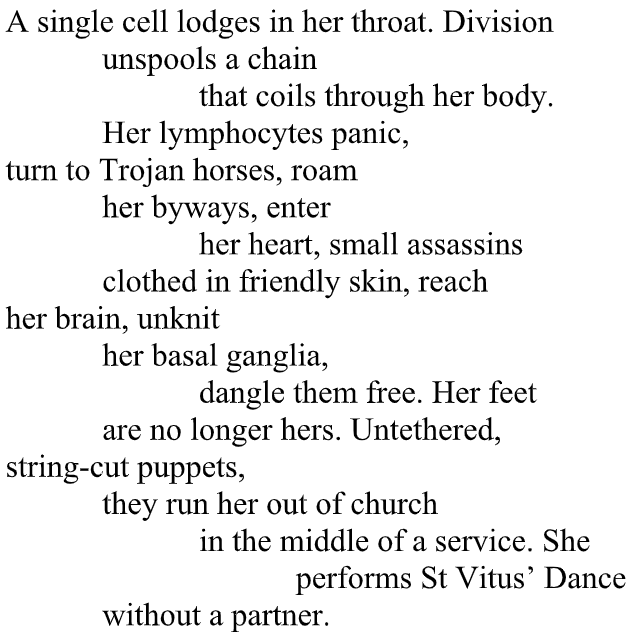
Fiona Cartwright (Twitter @sciencegirl73) is a poet and conservation scientist. Her poems have appeared in various magazines, including Magma, Mslexia, Under the Radar, Interpreter’s House and Atrium. Her debut pamphlet, Whalelight, was published by Dempsey and Windle in 2019 (Fiona Cartwright).

Severed – Kate Hendry

Severed

Blood has soaked her pyjama top when she appears,
holding out her hand – four-fingered – as if it’s no use
to her now. My instinct’s to save the severed part,
so I hoist her onto my hip and run to the kitchen
where she’s chopped an apple under the spotlights
hidden beneath the cupboard. The rest of the kitchen’s dark.
Outside is dark, with flickers of frost light when the moon
breaks through scurrying clouds. She’s heavy-limbed
and helpless in my arms, but the finger’s there amongst
half-moons of pink-fleshed apple. I swivel from worktop
to freezer, thrust it in with the tubs of raspberries
from the summer, collapse on the lino. She’s still offering me
her hand – half wanting the whole thing gone, half wanting
it fixed. Where is her pain? I’m wrapping her fingers
with crumpled tea towels pulled from the middle drawer
and she’s resting her head against the crook of my arm,
staring at a distant point by the door, as if at the doctors
for her jabs. I’m screaming for help, for someone to phone
for an ambulance, wanting to haul us both into the freezer’s
silver body, to be closer to the finger, the part of her
that’s permanently broken, permanently gone.

Kate Hendry’s poems have been widely published in magazines including The Rialto, The North, Mslexia, Under the Radar, Gutter, and are forthcoming in Poetry Wales and New Welsh Review. Her first pamphlet, The Lost Original, was published by Happenstance Press. @hendrykate

The mattress – Janet Hatherley

The mattress

Sometimes they sleep in
though the daylight is broad.

Two young people on a single mattress
under the bridge, the quilt up to their chins

still as dolls,
heads touching, black hair intertwined.

Sometimes the bed is empty,
quilt pulled back—and they are gone.

Pigeons on the girders, orange eyed,
nod and coo, a fluttering of feathers.

A bus brakes, each passenger absorbed
in their own music.

People’s feet splash by through puddles.
They glance down at a bed in the open

scuffed, dirty, damp
as they emerge from the bridge

to catch their connection.

Janet Hatherley’s debut pamphlet, What Rita Tells Me, was published May 2022 (Dempsey & Windle).  She has poems in Under the Radar, Stand and otherswon third prize in Second Light competition and was highly commended in Ver competition. 

Why We Leave – Gill Barr

Why We Leave

We children are told that we are moving
to the Waterside not far from our cousin.
We are pleased when we see the new house,
feel the scale of it, clatter up and down
the many stairs, lie on the new carpet,
smell the fresh paint, enjoy the airy rooms
without furniture, eat our lunch
like a picnic on the floor, but something’s
not right. Mammy is unhappy. She is crying.
She does not want to leave. She has lived
in the same streets all her life, no matter
that she is moving to a better house,
a bigger house – and safer.

On moving day we use a green van
that isn’t meant for removals. Mammy
is upset. In the van, she says out loud:
We are flittin’. She seems ashamed,
as if she has let the side down after all
these years. She doesn’t explain why
we can’t stay. We children cannot know
that our daddy has been threatened
in repeated late-night phone-calls,
has been told to get out
or face the consequences – he has been dragged
into an alley off Maureen Avenue and told at gunpoint
to get out or be shot.

Gill Barr’s poems have appeared in Bad LiliesThe Honest Ulsterman and The New European. She holds an MA in Creative Writing from Queen’s University, Belfast and is appearing at the Ledbury Poetry Festival in July 2022.

Skinned – Antonia Kearton

Skinned

The tomatoes are naked,
five of them, blanched, skinned,
a little indecent, something

not meant to be seen. The knife
is sting-sharp, dissects them
into precise quarters.

The recipe dictates de-seeded:
I push my thumb against the secret flesh,
feeling its moist resistance. It gives,

I scoop. Pulp, warm to the touch,
slick and tender, slips
between my fingers, seeds suspended

in umbilical sacks. I half expect
it to start pulsating, a stranded creature
straining back to its sea.

Detritus now, discarded, it’s swept
into the food waste, where it bleeds
among egg shells and onion skins, pale, lost.

Antonia Kearton writes, parents and is training as a person-centred counsellor in the Highlands of Scotland. She has been published in various journals including AcumenNorthwords Now and New Writing Scotland, and is intermittently on twitter as @AntoniaKearton.