Galia has poems in Bad Lilies, Atrium, Dear Reader, Streetcake, Zero Readers, Anthropocene and Eat the Storms. She has lectured at Shakespeare Institute, BFI, British Library and is committee member for the London Association for the Teaching of English. Follow her on Twitter @galiamelon
Keep a conker in your pocket to protect against broken bones. Plan escape routes and learn to tie double knots. Let yourself be guided by the mazy braille of garage walls whenever wearing a patch outside, and refuse to take off your Mighty Dynamo T-shirt on piping hot days for fear of getting a tan as golden syrup brown as your Dad’s. Practice jumping your garden gate and turning the front door key. Should your dream heavy legs weigh you down when pursued, throw yourself onto the grass and curl into a ball. With luck your enemy will fall badly. Timing is crucial. Go down too soon and you will look like a toddler playing peekaboo. He will turn you like a fox turning a hedgehog. Offer no resistance if he does, and do not worry if the finer points of his instructions escape you when struck by the whites of his Peter Lorre eyes. Sit up. Notice how the rooks jostle for space in the silver birches. The shadowboxing kite’s struggle to free itself. Develop a stoical attitude towards lineups and take refuge in alternative fictions. Stay home on test days with your cat watching Mr Ben and The Red Balloon instead. See the way the balloon follows the lonely boy from street to street like a stray thought bubble only he can understand. Harbour secret loves. Sarah Miles’s stutter. The roof of your mouth where your thumb rests snug as Cinderella’s slipper. The blue eyed girl in the opposite house whose gate springing shut is a glass thrown into a fireplace every time she leaves and returns. Cherish small freedoms, most of which you will gawp at in astonishment in the blink of an eye. The gap in the hedge. The open playing fields. Unlocked doors. Your mother’s voice calling you in just before dark. Try not to hog the background in photographs. The first time you drink too much and are sick in the nut bowl at Aunty Edie’s Christmas party, seize the opportunity to ask your father’s silhouette to hug you as you lie on your deathbed in the borrowed light from the landing, knowing that in the morning, if there is one, you can always deny the memory. Be careful with islands.
…
Mark Czanik was born in the sweet borderlands of Herefordshire, and now lives in Bath. Recent poems, stories, and artwork have appeared in MIR, The Rialto, Riptide, ROPES, Porridge, Pennine Platform, Morphrog, Black Nore Review, and 3AM.
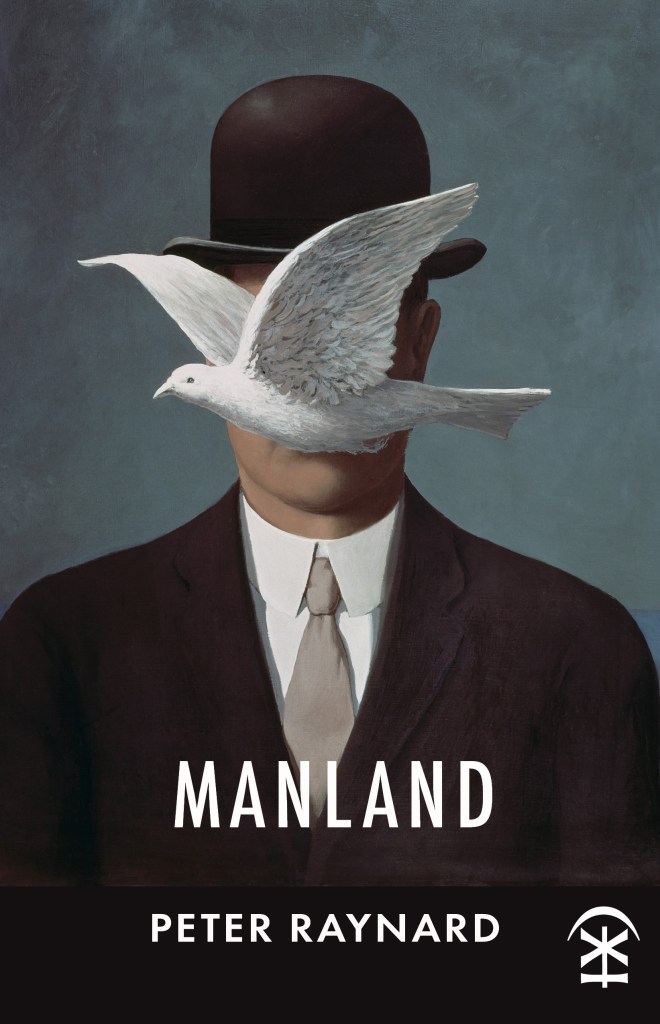
Our featured publication for September and October is Manland by Peter Raynard, published by Nine Arches Press.
Peter Raynard’s Manland is a bold, brilliant and outspoken new collection of poems that scrutinise men and manhood, mental health, working class lives and disability. Aloud and alive with music, wit, anger and rebellion, this is an accomplished, politically aware and vital book.
Raynard is a skilled observer, and these razor-sharp poems document parenthood through the lens of a stay-at-home dad, attempt to tell the truth about men and depression, study our cultural and social and medical relationships with drugs and drug-taking, and lay bare the realities of life at the sharpest edges of society. By turns frank, painful and bleakly funny, this humane and brilliant book encompasses pride and prejudices, the bonds between lads and dads, the toxic pressures of masculinity and the way illness and poverty irrevocably shape lives.
“In Manland Peter Raynard traverses the unstable terrain of working-class masculinity. His poems meet manhood in all of its banter and swagger; its persistent myths and dangerous silences. With his characteristic lyric verve, Raynard explores what it means to be a man, a father, a husband, and a son. The result is moving, candid, wise and tender, full of humour and hard-won insight. A convincing and beautiful book.” Fran Lock
“Part manifesto, part hymn, part raging lament, this collection takes apart the dirty engine of so-called masculinity, strips it down to its component parts, reconsiders and rearranges them using a dazzling array of poetic forms. It is only through acknowledging the strength of their vulnerability, these poems suggest, that men will be able to manifest change in our broken system where the violence of patriarchy is the enemy of us all.” Jacqueline Saphra
“One of the things I love most about Peter Raynard’s work is his voice. His voice is necessary, vital, passionate. It is the voice of anger at social injustice, a voice that deconstructs toxic masculinity, a chronicler of illness. Above all, it is the voice of truth. He tells us how the world is, not how we would like it to be. In this way, Peter Raynard is nothing short of a truth-teller.” Richard Skinner
…
Go On My Son
Previously published in the Rialto
…
Home-Father’s Beside Himself at the Seaside
previously published in the North
…
A Sestina to Die For
previously published in The Brown Book Anthology
.vhjl.
Peter Raynard is a disabled working class poet, and editor. Born in Coventry, he now lives in St Albans. He has been widely published in journals and anthologies. Peter edited Proletarian Poetry: poems of working class lives, for five years (www.proletarianpoetry.com), featuring over 150 contemporary poets.
He has written three poetry books; Manland (Nine Arches Press, 2022), Precarious (Smokestack Books, 2018), and The Combination: a poetic coupling of the Communist Manifesto (Culture Matters, 2018). He has been an associate of Culture Matters and alumni of Malika’s Poetry Kitchen where he was a member for five years.
Copies of Manland are available from the Nine Arches Press website.
just as the willow warblers return, as flies emerge and crawl to his eyes, as the first swallows test the sky, as the ground stiffens under his feet.
He shifts his weight from leg to leg. His apple rump has withered.
We put the case on either side back and forth across his sunken spine,
rubbing his neck and ears flicking away the horsefly he doesn’t swish his tail at.
His body prosecutes himself.
He doesn’t nudge me for a carrot nor intimate whether in his 36 years with us he has learned our tones
and understands the vet is coming tomorrow afternoon at 3.
…
Rebecca Gethin has written 5 poetry publications. She was a Hawthornden Fellow and a Poetry School tutor. Vanishings was published by Palewell Press in 2020. She was a winner in the first Coast to Coast to Coast pamphlet competition with Messages. She blogs sporadically at http://www.rebeccagethin.wordpress.com
Indie boys telling you to read House of Leaves is the new indie boys telling you to read China Mieville is the new indie boys telling you to listen to Pavement is the new indie boys telling you to listen to My Bloody Valentine is the new indie boys wearing Moog tshirts is the new It’s pronounced mogue is the new indie boys wearing flannel shirts is the new indie boys with one shaved eyebrow is the new indie boys giving themselves tinnitus from standing too close to the speakers at Lightning Bolt is the new indie boys telling you your fringe is the most interesting thing about you is the new indie boys buying Polaroid cameras is the new indie boys telling you this isn’t a date is the new indie boys telling you your little finger isn’t strong enough for bar chords is the new indie boys with fisheye lenses is the new indie boys learning Swedish is the new indie boys learning violin for their new folk-punk duo is the new indie boys telling you aren’t technically minded enough to study music technology is the new indie boys only buying vinyl because it sounds richer is the new indie boys telling you your voice has too much vibrato is the new indie boys telling you you would need cheekbones like Cleopatra to carry off that haircut.
Elizabeth McGeown is based in Belfast, Northern Ireland and has poems published or forthcoming in Banshee, Abridged and Under the Radar. She is the 2022 UK Poetry Slam Champion and her first collection ‘Cockroach’ is out with Verve in Summer 2022.
Well, it was the unionists, they had wealth, they had power they wanted to keep it to themselves and people like us, well, you were basically told who to vote for, but I was lucky because I was brought up in a mixed area Catholics and Protestants together and the house I bought with your mother was in a mixed street and I never had problems with anyone. We were all working people and we all had the same problem, barely enough money…
…
Gill Barr’s poems have appeared in Bad Lilies, The Honest Ulsterman and The New European. She holds an MA in Creative Writing from Queen’s University, Belfast and is appearing at the Ledbury Poetry Festival in July 2022.
Abandon your experiments. But how? And why? Is this a five second warning – leave everything and run? Stop. It is not clear how to abandon your experiments; the body has a range of measures to prevent your doing this, and the spirit’s an experiment unto itself. What an awkward phrase – unto itself. The spirit moves more easily than that. The spirit is as mobile as an itch. As long as it is, it is like an experiment. So there.
…
Nuala Watt’s poems have appeared on BBC Radio 3 and in anthologies including Stairs and Whispers: D/deaf and Disabled Poets Write Back (Nine Arches Press 2017) and A Year of Scottish Poems (Macmillan 2018)
Tiny monster, blanketed in the earth’s skin; the spirit of Achilles lives in you. You are a funny thing to fear.
I remember the sun soaked breezes of Brownsea where little fires jumped from branch to branch. Our assaults were always fruitful there.
Children have no mercy. We hunted eagerly, pulling you from the deep, calculated and slow. How we squealed at your shadows in the water.
Once captured, we gazed beadily at you scrabbling at the plastic walls. Soon we’d hold an army in our bucket.
When we tired of our labour, desiring sandwiches and dry clothes, we turned from soldiers to emperors.
Turning the bucket onto the deck, like toying gods we watched you race away, fleeing back to the salt from whence you came.
I wish I could have seen you floating down, parachuting into the dark as living meteors. When I see you now, I smile at the memory of those days.
How cruel we were then in our love; and still I yearn to fish again, reaching down into the sandy unknown.
…
Rachel Bruce is a poet based in London. Her work has appeared in The Telegraph, Eye FlashPoetry, The Daily Drunk, Hencroft Hub, and Atrium among others. Find her on Twitter @still_emo.
One day – how can I know which? – I lose my diary. Brain lurches into the chasm of the year: who is expecting me, and where? Who is even now drumming their fingers on Formica, alone with their agenda and their forbearing frown?
There is terror, then liberation. Everything is unexpected: friends drop by, then don’t. I make appointments, note them on a nearby banana, which I eat. The whole world is continually in rooms and restaurants without me.
Encouraged, I throw my alarm out of the window, put my watch in the bath. My phone is a landline, it is 1997 – I presume. It cannot remind me of anything and almost everything is yet to happen.
The days are short and frosty, then fresh, then long. At last I panic. It is nearing the time when I will meet you, but nothing can tell me when. The town hall clock, beneath which we will meet, is broken. I walk there every day as the sun goes down and look around me, wondering if I will recognise your face.
…
Livvy Hanks has an MA in Literary Translation from the University of East Anglia, and worked as an editor before moving into policy and campaigning work. Her poetry was most recently published in Lighthouse. She lives in Norwich. Twitter: @livvyhanks
Sometimes you catch the train into the city, the central library, for the archive. There you watch footage from the war, scan blown glass, missile drops, train stations.
A home video, newly surfaced, downloaded from an ancient iPhone: refugees crossing at Medyka, waiting to board buses, going west. The librarians know to call you when this happens.
You would know it anywhere, her coat; too distinctive to miss with its lupin-coloured quilting, fake-fur collar and the striped pixie hood she swore made her invisible.
Sometimes you catch the train into the city, the central library, for the archive, hoping to see her – you and her – that exact moment when she was there at Medyka, holding your hand. And then not.
By now you know them better than you know your own, the librarians – where they go for lunch, the park bench, summer, winter, their children and grand-children: whether their coats have hoods.
…
Jacqueline Haskell’s first poetry collection, Stroking Cerberus, was published by Myriad Editions in 2020 – https://myriadeditions.com/books/stroking-cerberus/ – as part of the Spotlight Books series. Her debut novel, The Auspice, was a finalist in both the 2018 Bath Novel Award and the 2020 Cinnamon International Literature Prize.



 atriumpoetry.com