Featured Publication – #MeToo: A women’s poetry anthology – Edited by Deborah Alma

Our featured publication for March is #MeToo: A women’s poetry anthology, edited by Deborah Alma, published by Fair Acre Press.

A brand new collection of largely new work, that rose up directly out of the collective rage from the #MeToo campaign on social media around the world at the end of 2017.
These poems are painful, angry, often difficult to bear, but the result of these voices singing together is one that is beautiful, full of sisterhood, strength, and recovery.

“This book contains the poetry of necessity and truth, exploding into the light, where it goddamn belongs. Please read these poems and then decide in what order you want to 1) cry 2) march 3) scream with relief and recognition 4) grab a sword-pen and write your own.” Amanda Palmer

“This collection is quite the rollercoaster: it made me cry with sadness – and with joy. I salute the courage of the women who have shared the pain of sexual harassment in verse that is lyrical, poignant and powerful. And I am also grateful to those who have shared their more hopeful experience in the poems that conclude this brilliant anthology. They have managed to find resolution and peace – as will readers of this outstanding collection.” Rachel Kelly.
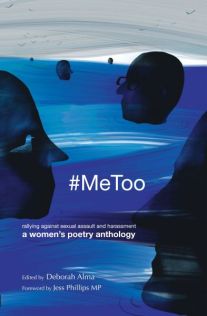
MeToo-front-cover-1


Body, Remember

Body, remember that night you pretended
it was a film, you had a soundtrack running
through your head, don’t lie to me body,
you know what it is.  You’re keeping it from me,
the stretched white sheets of a bed,
the spinning round of it, the high whining sound
in the head.  Body, you remember how it felt,
surely, surely.  You’re lying to me.  Show me
how to recognise the glint in the eye of the dog,
the rabid dog.  Remind me, O body, of the way
he moved when he drank, that dangerous silence.
Let me feel how I let my eyes drop, birds falling
from a sky, how my heart was a field, and there
was a dog, loose in the field, it was worrying
the sheep, they were running and then
they were still.  O body, let me remember
what it was to have a field in my chest,
O body, let me recognise the dog.

Kim Moore

(previously published in The Art of Falling, Seren, 2017)


Now, When I Think About Women

I think about Aziz Ansari’s Netflix special
where he asked the ladies in the crowd
how many had been followed—not cat-called—
actually followed down the street
by a man, many blocks, and how nearly
half of Madison Square Garden raised
their hands. I was home raising my hand,
thinking of moments in multiple cities,
how it was suddenly time to be scared.
Now, when I think about women,
I think about educated men who ask
if we secretly love being hollered at.
Don’t you kind of enjoy the attention?
Isn’t it flattering? It is 2017 and my best
friend says: a man in a car pulled up
beside me as I was bicycling, he was
jerking off to me, at me, I froze,
had to force myself to start pedaling
away. Last October, I consoled
my most enthusiastic canvassers: girls
who were chased and assaulted while
trying to get out the vote for the first
female president. Now, when
I think about women, I think about violence
and the threat of violence, how it’s like
an alarm inside going from zero to blaring.
The week I moved to New York
a girl my age went for a run.
People said it was her fault for dressing
that way, for taking that path. The article
said there was evidence of a struggle:
that before she died she bit her attacker
so hard her teeth cracked.

Emily Sernaker

(previously published on Poets Respond, 22 October, 2017)


My Fault

Consider my fault. It starts here,
on my temple so slim it could be a strand
of stray hair. Up close, at kissing distance,
it’s bolder, a slip of charcoal eyeliner.

When I find it in the mirror, it moves,
the creeping leg of a spider, a crack
across a plate left in the oven too long.
It parts a fraction like the lips of someone

sleeping, breathing in an unfamiliar bed
and when I think of that, it widens,
crescent-shaped, smile of a moon
above the house they’d say I shouldn’t

have been in, rim of the glass I shouldn’t
have touched. It turns into a zip, slit
of a pencil skirt and I can feel my body
opening, a fault-line in the ground

and everything – his hands and books,
the quartered bread, the wine, the room
I don’t remember entering – loosed
and falling into me. I turn

into a road that always takes me back
to the same place: pit town, midnight,
frost across the playing fields
as I go silent underneath

the broken roundabout, zig-zag
below pavements, terraces, the winding wheel
crossed with a thin seam of light and no-one
can touch me, not for centuries.

Helen Mort


Spartaca

in the room/ in the street/ on the stair/ where some men make free
in plain sight or in secret as if we were sweetmeat/to dip
fingers in and then forget – it is the being alone
afterwards that numbs and maims, utterly
alone in the silence of it/where shame creeps in/
stuns dead/but now we rise, all women
fondled and hurt and licked in acid jokery and in hate,
pets, sweethearts, loves, darlings, humourless bitches –
we stand together, each one a Spartaca
no longer silent or alone: each voice stronger,
massing, alive, a wild murmuration
of me too/me too/me too

Spartacus was a rebel slave hunted down by the Romans to be crucified.
Asked to identify himself by soldiers, everyone in the crowd around him
stepped forward and said ‘I am Spartacus’.

Pippa Little


The #MeToo anthology is available to buy from the Fair Acre Press website. All profits go to Women’s Aid. A full list of events to showcase work from the anthology is also available on the Fair Acre Press website.
Wood Garlic – Anna Saunders

Wood Garlic

In the darkness of the ancient woods
a galaxy of fragile constellations –
the spiked flowers of the ramsoms.

The bulbs once harvested for Hecate,
brushed smooth of soil
placed on rocks for the moon goddess.

Bear Leaf – its other name.

Can you imagine the furred beast – talons
like scissors, ripping the stitch of root
from the dark weave of earth?

What a plant! Those delicate blooms,
mimicking the heavens
coupled with that smell –
salty, ripe, heady as hot flesh.
The body’s incense, smouldering.

Aren’t we all wild garlic
rooted into the dark woods

offering ourselves to the gods,
cowering from rough paws,
blazing our pure stars?


Anna Saunders is the author of Communion, (Wild Conversations Press), Struck, (Pindrop Press) and Kissing the She Bear, (Wild Conversations Press) and Burne Jones and the Fox (Indigo Dreams) and the forthcoming Ghosting for Beginners (Indigo Dreams, Spring 2018). She has received three Arts Council Awards and has been described as ‘a poet who surely can do anything’ by The North  and ‘a poet of quite remarkable gifts’ by Bernard O’Donoghue.


Lot’s Wife – D A Prince

Lot’s wife

Another of God’s jokes, we said. A pillar
of salt, a nameless, faceless fact.
Jinxed for her one last backward glance
to where home burned.

One of RE’s more memorable plots. If this
were Chemistry there’d be the formula;
or Geography, erosion (rain and wind),
perhaps what farming and the economy gained.

She got on God’s wrong side: simple enough
and easy (like the apple) for exams.
We’d spill it like dry beans, and pass.
Move on. Nothing to linger with, unless

the business by the daughters (rattled through
just at the end-of- lesson bell). We’d learned
enough to giggle, look away and out
and never think of ever looking back.


previously published in Common Ground, HappenStance Press, 2014

D A Prince lives in Leicestershire and London. Her second full-length collection  – Common Ground, HappenStance Press, 2014  –  won the East Midlands Book Award 2015.

To The Lady At Dragonfly Studio – Harry Gallagher

To The Lady At Dragonfly Studio

She is a busy wee body,
butterflying from loom
to lambing
via granddaughters.

She is a rat-a- tat-tat
of laughter and nonsense,
ricocheting down the glen.

She is a mountain’s Ma Walton,
weaving a web
of Winter woollies
for all and sundry
and all of their friends.

She is an organic power station
for a father and mother
and husband and children,
who she cajoled across two countries
because only she knew
it was the right thing to do.


Harry Gallagher’s new collection, Northern Lights (Stairwell Books) was published in September 2017.  He has been published by The Interpreter’s House, Prole, Ofipress, Rebel Poetry and many others. He performs live nationwide and will read for you if you ask nicely!  www.harrygallagherpoet.wordpress.com

New World – Elly Farrelly

New World

Those were the nights of quiet stars,
of coffee brewing in the blue enamel pot
and you as always dressed in red,
singing Manisero–
The peanut vendor’s song.

All evening I listened
while your friends’ playful fingers
rattled and tapped taut skins,
maracas, bright beads in hollow gourds,
tumbled rain in a cactus stalk. I tried.

But your tricky rhythms
tripped me every time
scraping the guiro,
or awkwardly shaking something
as best I could yet always,
somehow out of sync.


Elly Farrelly lives in Glasgow. Her  poems have been published in From Glasgow to Saturn, The Glasgow Review of Books and have  been included in two  anthologies.  As well as writing poetry she is also a songwriter and performing musician. Website www.ellyfarrelly.co.uk

Return To Mardale – Jonathan Humble

Return To Mardale

Confused, she stands at water’s edge;
a shadow, lost by this unfamiliar lake.
She wonders why the bells are silent.
No church, no school, yet still she listens
for well loved songs and laughter.

An eagle soars, commands ancient heights,
the realms of Harter Fell below his wings.
Her thoughts rise too, catching thermals,
heart leaping over High Raise climbs.

Old Chapel Hill and Bridge return below,
with Dun Bull Inn; dark snug and warm hearth.
Stone cottages now evoked in thoughts
once buried in Westmorland’s fairest valley,
before the flood, before the tears.

Over rutted track, a farmer’s cart rattles,
decked in ribbon, known faces smiling back,
with the echo of a lover’s voice in the air,
as Whitsun bells peel to call the dead.

Confusion gone, she enters Haweswater.
Now content to fade, as under trees in full leaf,
she walks a submerged path in a drowned village.
And singing songs, she meets again with friends
who once had lived in Mardale Green.


Note: Where today you’d find Haweswater reservoir in the Lake District, there was once the village of Mardale Green. Back in the 1920s, an Act of Parliament was passed allowing Manchester Corporation to build the reservoir to supply water for the urban areas of the north-west of England. Buildings in the Mardale valley were demolished, families were relocated and by 1935 the new reservoir was established. Occasionally, in periods of drought, the old dry stone walls and bridge make a ghostly reappearance, only to be submerged once water levels rise again. 

Jonathan Humble is a teacher in Cumbria. He writes poetry and short stories. His stuff can be found in a number of different publications and on his poetry blogs ( https://jhpoetry.blogspot.co.uk and https://northernjim.wordpress.com ).

The Wolf At The Door – Kitty Coles

The Wolf At The Door

At the full of the moon,
I hear his long nails scratching
against the doorframe,
and his quiet whine,
its syllables
his rough approximation,
his lupine effort,
to pronounce my name.

You think his nails
must be the fingers of trees,
tapping and scraping
at our bricks and mortar.
You think his whine
must be the wind
in their branches
and the yellow beams
that slide between the shutters
must be moonlight,
not the light of his wet eyes.

He is stirring my skin
and setting my blood
on edge. His shadow
creeps on the wall
like Nosferatu.
My tongue lies furred
and still with his silences.

When I open the door,
stars blaze
behind my eyelids.
A rush of dry leaves
blows in, its decrepit odours.
He stands on hind legs,
like a man,
coat thick and bloody.
His jaws drip freely
with their offering.

What is that gift he holds,
where did he find it,
why must I take it in my gooseflesh hands?


Kitty Coles is one of the two winners of the Indigo Dreams Pamphlet Prize 2016 and her debut pamphlet, Seal Wife, was published in August 2017.  www.kittyrcoles.com

Befriending the Butcher – Anna Saunders

Befriending the Butcher

When my father first walked in to the shop,
the pheasant dangling clumsy from a string like a plumy yo-yo,
and asked the butcher how to prepare it for the pot,
he didn’t expect to hear Mozart playing. Or to talk Kierkegaard

as the feathers were plucked. A Thomas Hardy hero
striding the coast before work,
chin cleft like the rocks at the estuary edge,
we thought he’d mark the whole country with his steps.

He spent his days dressing flesh
preparing Primal Cuts and his nights – carving wood,
reading brick-heavy biographies of Larkin or Keats.

Rude health didn’t last till retirement.
We visited him in a bungalow on the other side
of the tracks, his hand-carved bird tables trembling
on long stalks as the trains thundered past.

There we sat, over-shadowed by Victorian furniture,
none of that blood-bled modern stuff,
just oak, or mahogany,
on chairs as dark and immense as the Wagner
which poured into the room, slowed down

by its own heft. Around us – shelves of Folio editions
fat spines emblazoned gold
row after row of corpulent companions
in brass and buttoned regalia.

No longer able to walk, he scored the floor
with wheel chair marks as if ticking items of a list

and the single bar of the fire was a winter sunset;
a thin scarlet line, blazing with its own heat
as it slipped down silently, into the dark.


Anna Saunders is the author of Communion, (Wild Conversations Press), Struck, (Pindrop Press) and Kissing the She Bear, (Wild Conversations Press) and Burne Jones and the Fox ( Indigo Dreams) and the forthcoming Ghosting for Beginners ( Indigo Dreams, Spring 2018). She has received three Arts Council Awards and has been described as ‘a poet who surely can do anything’ by The North  and ‘a poet of quite remarkable gifts’ by Bernard O’Donoghue.

Midnight – Jack Little

Midnight

The white wash, crumbling windows
will not open, dust encased, glistening
and wishful under lampshade-less bulb

midnight and a sky night train passes to my right: I search for stars
all prearranged and ordained against the impossible
redness of Mars, but one shouldn’t mix colours
when the pallet is already a dirty purple, you’ll make a mess

and to the left you lie crumpled, the crinkling sound of graphs
on primary school tracing paper, the scratchy and the delight
in being wasteful – the heating on, the veins pulsating
the ripping off of clothes on the night I close my notebook.

My eyes are itchy and the pebbledash ceiling causes nausea,
and cracks imperceptibly- havoc in a broken yoke. The tiny comets
of the universe, dance beyond reach of the slow grasping hands of babies
wishing you farewell, the paradise of midnight Earth,
the fear of asymmetry

home to a god we so desperately want to believe in.


Jack Little (b. 1987) is a British-Mexican poet, editor and translator based in Mexico City. He is the author of ‘Elsewhere’ (Eyewear, 2015) and is the founding editor of The Ofi Press: www.ofipress.com He was the poet in residence at The Heinrich Böll Cottage on Achill Island in Ireland in July 2016.

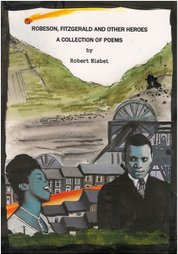
Featured Publication – Robeson, Fitzgerald and Other Heroes by Robert Nisbet

Our featured publication for February is Robeson, Fitzgerald and Other Heroes by Robert Nisbet, published by Prolebooks.

The poems collected here are of an age, they are of a place – Wales, The Valleys and Southern peninsula – but their themes, their wit, the emotions they elicit are universal. Amongst the nostalgia, the musical connections, these poems are peopled with unforgettable characters and their stories are told through a poet’s honed craft, and at times, with a wicked humour.

‘Throughout, the people and their stories that populate these pages are vivid and authentic, the emotional force cleanly depicted with concrete imagery and language that rarely disappears into abstraction, and therefore holds your attention closely. I read the whole thing in one sitting and never felt bored. Which is as good as it gets, really.’ Paul Vaughan, Algebra of Owls.

Robson, Fitzgerald and other heroes


Epiphanies

Three cars, unwittingly together, drive
off the motorway and into Pembrokeshire.
The BMW has its family, a nucleus,
and Mum sifts notes on a priory hereabouts,
the burial chamber, Iron Age fort. The region
is renowned, she tells them, for spiritual things.

The Fiesta, overtaken earlier, straggles.
The couple here are younger (not that young,
certainly, but eager, newly together).
They stop in a clearing, their embrace takes in
the smell of hawthorn, farmland after rain.

The Astra from Rotherham is pumped full
of little children, iPods, Gameboys, games.
Since the motorway, the kids have vaguely
clocked cows and sheep and stuff, but
now, just past Brynberian, a herd of cows
(a hundred head) crosses their path,
off to milking. The Astra stops and ponders,
but one cow detaches herself, nuzzles
a side window, and Jason, aged nine,
is eyeball to bloodshot eyeball with a
fucking great cow. The cow (and she too
has a name, Jason, she’s Rhiannon
and she’s a Friesian) rubs and bumps
the window with her trumpet of a nose,
and exhales enormously.
Jason, now mistily obliterated,
will remember this moment
for the rest of his bloody life.


As You Like It in the Bishop’s Palace
An open-air production in St. David’s
 
A coastal summer and cathedral bells
and the rooks’ hauteur give us this night in Bardic country.
Foreground, romance in a forest.

From the back row of canvas chairs
they watch, they two.
They have not yet adventured.
But the voice of the lovers is reaching them
from the forest, from the palace,
and as eight o’clock deepens to a cooler nine
they draw the blanket more around themselves,
nestle.

Rosalind and Orlando are eighteen, nineteen,
but grown to love’s confidence
in the play’s disguise.
The playwright stakes out his promise:
Hang there, my verse, in witness of my love.
 
The watching two are in thrall.
Their hands, beneath the blanket,
steal together, clasp,
as in the happy ending of a play.


A Sudden Summer Sun on St. Bride’s Bay

Towels and Colas gritted by the sand,
more brown than golden sand on a day when
a warm bluster of westerly wind
is the beach’s feature.

She is just shy, gauche really, seventeen.
She just does not want
to walk down the beach on such spindle shanks,
such sad bare legs exposed

She huddles behind the windbreak until
the Mediterranean moment
when the sun rushes out, just as she peels her way
through the spider-written letter
from the boy from France.

……………………………………………………………………..(What do we know of him? Seventeen also.
…………………………………………………………………………………………………Not gauche but not adroit.
………………………………………………………………………………………. Loves languages and music and,
……………………………………………………………………………. in the grace of a reserved adolescence,
…………………………………………………………………………….loves the girl to the point of adoration.)

She reads his civilities, pleased, and then the phrase,
If I cannot become to see you this August,
my summer, he will be ruined 

and she flowers, and walks,
on nicely-rounded spindle legs,
to the water, in the sun,
feeling herself a mademoiselle,
a mannequin, a belle.


Previous publication credits are Smiths Knoll, Scintilla, and Snakeskin/Shortlist for the Wordsworth Trust Prize 2017, respectively. 

Robert Nisbet is from Pembrokeshire, teaches creative writing to a range of classes and has been publishing poetry widely in Britain and the USA for 12 years. In 2017 he was shortlisted for the Wordsworth Trust Prize and his short collection, Robeson, Fitzgerald and Other Heroes, was published as the winner of the Prole Pamphlet competition.

Robeson, Fitzgerald and Other Heroes is available to buy from www.prolebooks.co.uk