The truth about cats and courgettes – Hannah Stone

The truth about cats and courgettes

My cat spurns laps and hearths,
shuns stroking;
wefts her tail with sluts’ wool
under the spare bed.
Spine retreats into corrugated peaks.

I do not speak of these signs
when I call my mother.
In turn, she neglects to mention
that the vegetables I left prepared in her fridge
last month are slime in the salad drawer.

We exchange scripted comments,
about meals to be enjoyed
and the companionship of cats.
Like her hand, holding the phone to her ‘good’ ear,
mine now has freckles which outstay the summer.


Hannah Stone co-edits the poetry ezine Algebra of Owls and convenes the poets/composers forum for Leeds Lieder Festival. Her first collection, Lodestone, was published by Stairwell Books in 2016 and Missing Miles by Indigo Dreams Publishing in 2017.

Featured Publication – How To Parallel Park by James Davey

Our featured publication for April is How To Parallel Park by James Davey, published by V. Press.

“Stark, poised, precisely observed, James Davey’s poetry well demonstrates how much more emotion is conveyed the greater the restraint. The poems also exhibit an impressive musicality, from the lilting to the percussive. Each poem rewards rereading.” Carrie Etter”

“These poems by James Davey are vivid, articulate and entertaining. They evoke the peculiar intensity of childhood fears, the angst of adolescence, the tremors of first loves. Davey has a gift for clear-eyed dramatic presentation, as well as an often-humorous take on human condition and a true empathy for the various characters he comes across, be they ‘pyroman’ a down-and-out who accumulates trash to burn, the terrified child taken on a hunting trip, or the lover discovering the ‘colours’ of a girlfriend. This is a promising and well-wrought debut.” Amy Wack

“Davey’s work is confident, crafted, elegant in its simplicity. The poems are full of moments of recognition for the reader, subtle emotive power balancing understated humour. I trust him to show me something worth seeing with no fluff around the substance.” Anna Freeman
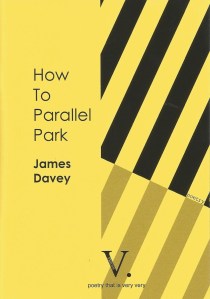
HTPP


Pyroman

We often see him through the playground railings,
arms loaded with odds and ends rescued from scrap heaps

and rubbish tips: a floral lampshade, three-legged chair,
and hanging round his neck, pairs of tatty trainers

tied together by their laces. He shuffles past in his grubby mac,
a scabby dog yapping round his ankles

and we rush to taunt him – Filcher! Filcher! –
but never cause a flicker

in his thousand-yard stare.
Sometimes we see him through our classroom windows

and stand on our chairs for a better look
at what he’s salvaged, each time his treasures more bizarre.

One day he stutters past dragging a soiled mattress,
the next carrying a child’s plastic kite.

On a tinder-dry morning in July, a pillar of black smoke
rolls above his rooftop across the street.

The playground freezes – our heads back, mouths wide open,
the smell of burning plastic heaving toward us,

the crack and burst of flames merging with the long high
whine of sirens in the distance.

Six months later I pass him on the street, his soot-grimed face
aglow, carrying a wooden crate, a cricket bat, a headless doll.


When You Want it 
Late night alcohol and cigarettes…when you want it

Perform a U-turn when possible, says the woman
in my sat-nav – I call her Jane.
So I swing across the road
in one practised motion,
the sweep of my headlights
igniting the fine rain needling the pavement.
Bottles of Cab-sav, cans of Carlsberg,
and a kaleidoscope of Alcopops
rattle in the boot of my Fiat Panda
as Jane directs me to my next customer.
Drive three hundred yards, then turn left.
Only the restless and the homeless
wander the streets at this hour.
A girl collecting cardboard boxes outside Asda,
plastic bags wrapped around her shoes,
pulls up her hood and takes a swig
from a plastic bottle as I drive past.
At the next roundabout, take the second exit,
says Jane – and as she speaks
she appears in the passenger seat,
plump with her third child,
her hair cut shorter than normally – it suits.
She tells me the latest on the children
and her husband, Derek, an accountant
with a confident moustache,
describes their new house in Hampstead
with a gravel driveway and bay windows.
The baby is kicking; last week their cat
burned its tail in the toaster.
I can smell her perfume, citrus bloom.
The hairs rise on my arm.
In two hundred yards, turn right, she says.
You have reached your destination.
I pull into an unlit cul-de- sac,
park between a wheel-less car
propped up by four small pillars of bricks
and a soiled mattress dumped by a fence.
A slice of light splits the darkness
as someone inches open their front door.
A sallow face peeks out from behind the chain.
I’m waved forward.
Perform a U-turn when possible, says Jane.


How to Parallel Park

My instructor takes me to a country lane
to practise my parallel parking.

I slip the stick into reverse and start backing up
into a gap between two parked cars.

I take it steady, work my clutch control.
I rotate the wheel clockwise through both hands.

I check my mirrors. Listen to the engine’s rev
ticking over nicely.

I draw even with the rear of the first parked car
(a red Clio with a nodding dog on its dash)

notice a bare foot pressed against its window;
a bare arse bobbing up and down –

a muffled chorus of love-moans bluing the air.
My instructor insists we abandon the manoeuvre.

I restart my stalled engine. I pull away nice and slow,
making sure to check my mirrors.


Previous publication credits are The Interpreter’s House, New Walk and The Echo Room, respectively. 

James Davey grew up in Bristol and currently lectures in Creative Writing at Bath Spa University. Before returning to the U.K. in 2014, he spent three years working in Catania, Sicily, as an English-language teacher. His poetry has previously appeared in journals including Poetry Wales, New Welsh Reader, Stand, The Warwick Review, Ambit, New Walk, Agenda, and The Interpreter’s House. How to Parallel Park is his debut poetry pamphlet.

How To Parallel Park is available to buy from the V. Press website, here.
 

At the Student Union Café Bar – Eleni Cay

At the Student Union Café Bar

The professor reduced cloud journeys
to four cardinal directions.
Colours of leaves to four seasons.

Said that snowflakes are just molecules
attracting each other through
Newton’s predictable laws.

You wink back at me. We take
the legs of the coffee table,
return them to trees.

The waiter pixelates us for his website.
Our kiss rises up with the steam
of our coffee to the bitter

blueness of the sky. The moon makes
the motorway a river in which we can
swim however we like before we drown.


Eleni Cay is a Slovakian-born poet living in Manchester, UK. Her poems were published in two pamphlets – Colours of the Swan and Autumn Dedications – and featured in MK Calling 2013 & 2015. Eleni’s poems were included in anthologies such as Mother’s Milk, poetry magazines such as Envoi and Atticus Review and on Button Poetry. A full collection of translated poems was published by Parthian Books in July 2017 and a pamphlet is due in autumn 2017 by Eyewear Press (The Lorgnette Pamphlet Series).

W: www.eleni-cay.com 

T: @EleniCay


A Stop on the Way – Chris Hardy

A Stop on the Way

Instead of asking,
This one or the next?
turn into a lane
where signposts promise
quiet hamlets
settled in fields.

One offers ‘St Stephen’s Church’,
a Victorian tower on older walls,
and a pew labelled
‘In memory of Lucy,
who loved this place’.

Summer heat but after rain
the grass and trees welcome it.
We sit awhile, long enough,
then drive back to the highway
that heads west over the hill,

the highest point round here.
Beyond it farms, rivers,
lanes and crossroads,
all the way to the coast
where we must go
together.


Chris’s poems have been widely published.
He is in LiTTLe MACHiNe www.little-machine.com 
His collection ‘Sunshine at the end of the world’ is published by Indigo Dreams Publications. 
http://www.indigodreams.co.uk/chris-hardy/4593968553
‘A guitarist as well as a poet Chris Hardy consistently hits the right note”. Roger McGough.

Cognitive Behaviour Therapy for organs in your body – Abegail Morley

Cognitive Behaviour Therapy for organs in your body
[Step One]

This time she knows not to repeat her mistakes, picks
thoughts as if plucking feathers from newly-killed birds
until their punctured skin rises to meet her palms. This time,

she says, mouth moving so in sync with words whirring
in her head a duet slides in and out of melody. This time
is not the same. She thrusts bloodied fingers to her lips,

stands back from the sink, chicken entrails slick on the lino,
reaches inside for her own innards, lets them unspool until
she can’t see which heartbeat is hers. She tells the walls,

the cupboards, the locked-fast door that her heart has shrunk
so small it no longer shows its weight on kitchen scales ‒
watches her lungs slowly deflate in their own irrelevance.


Abegail’s recent collection is The Skin Diary (Nine Arches). Her debut, How to Pour Madness into a Teacup, was shortlisted for the Forward Prize. In the Curator’s Hands is new from IDP. She’s “One of the Five British Poets to Watch in 2017” (Huffington Post), blogs at The Poetry Shed and is co-editor of Against the Grain Poetry Press.

In spring, energy – Jean Atkin

In spring, energy

The moss is drying
on Lan Fawr.
The summit has its own
small stiff wind
and we descend
to eat our sandwiches,
lean our backs
to the egg-yolk gorse.
A buzzard hangs
over a long field slated
with solar panels.
Sheep graze under electricity.
When we turn our heads
the Stiperstones
are nudging at blue sky,
whose streaks
slide east.


Jean Atkin has published ‘Not Lost Since Last Time’ (Oversteps Books) also pamphlets and a novel.   Her recent work appears in Magma, Agenda, Ambit, Envoi, The North, Earthlines and The Moth.  She works as a poet in education and community projects.  www.jeanatkin.com  @wordsparks

Waiting outside the gynae-oncology ward during the Olympics – Rebecca Gethin

Waiting outside the gynae-oncology ward during the Olympics

In Rio, it’s women’s beach volleyball. Beside me,
a woman is wearing a gown and white compression socks.

The athletes in Rio have tiny shorts and bikini tops.
We nod to one another. A man is glued to the women

in Rio as if interested in who wins and loses.
He’s here because I’m scared, she mutters.

We flick through our mobiles – no signal. In Rio,
bodies are lithe, feet and toes bare on the sand. Upstairs

they’re in scrubs while we stare at the match in Rio
without any understanding of the rules.


Rebecca Gethin:  All the Time in the World (Cinnamon Press) and A Sprig of Rowan (Three Drops Press) were both published in 2017. An earlier collection and two novels were published by Cinnamon.  She runs the Poetry School’s monthly seminars in Plymouth, has been a Hawthornden Fellow and her website is www.rebeccagethin.wordpress.com

Thé avec Imogen et toi – Sharon Larkin

Thé avec Imogen et toi

It’s exquisite torture sitting this close to you in polite company
with the restraint of Earl Grey and amuse-bouches on a doily

when what I think I’d like is you, alone, and a slug of vin rouge,
our tongues entertaining more than each other’s ears

on some good old-fashioned shag pile
somewhere other than Imogen’s bungalow.


Previously published in The Rat’s Ass Review – Love and Ensuing Madness, May 2016

Sharon Larkin has been widely published in anthologies, magazines and on-line  and has a pamphlet forthcoming from Indigo Dreams. She founded and edited the Good Dadhood poetry project, co-runs Poetry Café Refreshed and is Chair of Cheltenham Arts Council and Cheltenham Poetry Society.
Website: https://sharonlarkinjones.com/published-poems

On Good Days – Jonathan Humble

On Good Days

On good days, the voices were quiet.
He’d fumble the razor, indulge in muttered
early morning profanities, yet still wear
his hope like an old boxer’s dressing gown.

Water cascading over knotted hands,
temperature rising as the boiler kicked in,
he’d tickle the soap trout like a novice,
splashing water over threadbare slippers.

Thin ribbons of steam wafting upwards,
enfolding the air, would draw him towards
the mirror like an opponent’s face drifting
into focus, as abused senses slowly sharpened.

And noticing rain, he’d open the window,
listen, breathe, let the irritations abate,
feel the control return, while in the glass,
his reflection slowly misted over.

He might wipe the condensation away, look
for memories, distort the image, try to summon
different eyes, willing someone else
to the mirror than the one expected.

But on bad days, on days where the reflection
remained obscured, through early morning mist,
the eyes would have no hope;
he would wait for the voices to return.


Jonathan Humble is a teacher in Cumbria. He writes poetry and short stories. His stuff can be found in a number of different publications and on his poetry blogs ( https://jhpoetry.blogspot.co.uk and https://northernjim.wordpress.com ).

Relief – Ceinwen E. Cariad Haydon

Relief

Coming down from high Chew Green,
my legs stretched, my rucksack back-stuck,
I hunger for chips and fresh-baked chicken pie
with ice-cold Guinness,
as my senses sing of hills and sky.

Journey almost done, my feet
slip-slide on greasy flagstones
when suddenly, I hear the gurgling burn
stitched with fretful baas.
I see a wean crying, stuck
knee-deep in oily bog-land mire.

And her dam blait alto-tones,
raucous and resigned
to the muddy loss of her bairn.

My boots stall
sucked down by sludge,
and thistles prick my legs
as I move slowly
to clutch the lamb
by her lanolined, rough-wool coat.

I heave hard.

Her eyes are blank, terror-misted,
and her black, bony hooves
jab sharply on my shins
as she glucks free, wobbles,
sneezes and stumbles to her mam.
Tired and splattered, I mind a time, way back:
when my own child returned with a stranger.


Notes:
blait: Scots – to bleat
bairn and wean: Scots and Northern English – babies or the young
dam: farming term for livestock – mother

Ceinwen lives in Newcastle-upon- Tyne and writes short stories and poetry. She has been
published on internet sites and in print. She is currently completing her MA in Creative
Writing (Newcastle University) and embraces being slightly bonkers.