Featured Publication – The Healing Next Time by Roy McFarlane

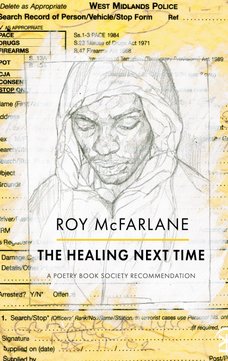
Our featured publication for December is The Healing Next Time by Roy McFarlane, published by Nine Arches Press.

Roy McFarlane’s second poetry collection, The Healing Next Time, is a timely and unparalleled book of interwoven sequences on institutional racism, deaths in custody and of a life story set against the ever-changing backdrop of Birmingham at the turn of the millennium. Here forms a potent and resolute narrative in lyrical and multidimensional poems which refuse to look the other way or accept the whitewashed version of events.

‘Claudia Rankine’s ‘Citizen’ contains the following key exchange from a visit to the UK: “Will you write about Duggan? The man wants to know. Why don’t you?” Few rose to this challenge but Roy McFarlane’s distinguished new collection The Healing Next Time takes on a whole history of official abuse and killing here with powerful and technically various poetry. McFarlane traces our hostile environment for new citizens, particularly those of colour, into some ugly corners, but it is a book of great love too, even when he’s dancing with ghosts, as he does here in a wonderful poem of that name. I cannot recommend The Healing Next Time enough.’  Ian Duhig

‘The American poet Claudia Rankine has written: ‘poetry has no investment in anything besides openness. It’s notarguing a point. It’s creating an environment.’ Rankine is one of the presiding spirits of Roy McFarlane’s second collection, The Healing Next Time. The environment he creates is one where the lyric thrives, but in audacious and bold forms crucial for a new brand of poetry. McFarlane’s poems celebrate who he is and where he’s from, never forgetting the sorrow and anger that accompanies what it means to be black and British today. Most powerful is a sequence of modern sonnets that track the terrible roll call of wrongful deaths in custody – moving and graceful memorials to ordinary men and women. His ‘openness’, to quote Rankine, comes from his honesty, his love for humanity and his outrage at injustice – this is an essential book for our times.’ Tamar Yoseloff
TheHealingNextTimeCover


1999 – Parts of a broken man

………………….the more a man has the more a man wants
……………………………………………………………………– Paul Muldoon

i.
On Sunday, the preacher’s speaking of revelation and repentance,
the end of the world is on the lips of news reporters.
Cults are spreading and in the basement of a computer department
they’re preparing for the invasion of the millennium bug –
…………………………………………we watch for the skies and miss the stones at our feet.

*

The family man is shooting a basketball, graceful
in motion and everybody’s watching the flight of the ball
reaching its zenith, then beginning to fall. All things fall;
summer rain, falling from grace, the fallout
…………………………………………….of a sordid affair; the ball’s falling.

*

Breadfruit, soursap, plantain. A Saturday morning ritual,
roles changed, the son takes his mother to a Caribbean stall
in Bilston market. She’s not as strong as she used to be,
her breathing laboured, but she snaps the heads, digs out the eyes,
……………………………………………….yellow yam, sweet potato, dasheen.

*

A daughter will be born soon, an olive branch
for the family man treading water after storms ceased.

ii.
A nation hears no evil, sees no evil, speaks no evil. A son’s blood,
a father’s sweat and mother’s tears will lead a retired judge,
and three diverse men to inquire in towns and cities
of the racism that kills. And the rocks will hear and rivers speak
\\\\\\\\\\\\\\\………………………………of the death of Stephen Lawrence.

*

After hearing of the death of Grover Washington Jr,
the family man’s falling asleep with his Walkman headphones;
between winelight and come morning, memories are awakened,
whirl of cassette tapes beginning the re-wind of illicit love:
…………………………………………….just the two of us building castles in the sky.

*

Late meeting, lips kissing, hands feeling, fingers…
Her halter-neck top has been drawn over her head,
the night air touching her breasts, powdered
with a flurry of goosebumps, he’s sucking greedily
……………………………………………….and it all begins again.

*

A mother’s sharing roast breadfruit, ackee and saltfish
with a warning: please, set your house in order.

iii.
There are no purple skies but the prophet Prince lives
to see his words come alive, as people party like it’s 1999.
We could die any day. James Byrd Jr died the year before;
lynching-by-dragging, hate driving for miles in a pick-up-truck,
,,,,,,,,,,,,,,,,,,,,,,……………….,……….driving from century to century.

*

He’s speaking at public inquiries, tongue heavy with injustice,
teeth grinding to the sound of another death in custody.
There’s a bitter taste he needs something sweet; later in a private place
her labia moistened by his tongue, she guides his erection deep
……………………………………………..and voices are lost in each other’s mouths.

*

He’s singing gospels, praying repentance into the early morning,
following traditions from sunny islands, avoiding the tears of his wife,
who’s dreaming of impending sorrows. The Millennium arrived
drunk with Hogmanay, midnight mass, Kwanzaa blessings and Prince
………………………………………………alighted from the heavens in a purple robe.

*

A new job, but the more a man has the more a man wants.
He leaves doors unclosed, doors that ache in the wind.


Their hands

Trying to fashion a world that will hold all the people
All the faces, all the adams and eves and their countless generations
………………………………………………………………..
For My People – Margaret Walker

Their hands loved and caressed, cajoled the fears out of lonely nights,
………….fed men with hope and washed the indignity off their faces
………….and in the cold morning would unwrap themselves from men
………….who’d venture another day into fogs of uncertainties.

Their hands worked too. Worked in mills and factories,
………….mopped floors, fed people, cut cords of the new born
…………..worked day and night for pay packets that weighed
…………..less than those called Mary and Jane.

Their hands knew change, change in their bodies, seasons
………….of blood that ceased, the beginning of life and in those times
………….found God, lost God, loved God, became gods bringing life
………….into this world and sometimes cried in the twilight of stillbirth.

Their hands have brushed the dust of hate from paths and doorsteps
………….scrubbed hallways clean of the ignorance of others but sometimes
………….bitter blood seeps from outside and anger boils over from generation
………….to generation turning hands into clenched rage on the eve of riots.

Their hands have lost the gloss of youth, are loose with veins like
…………tree roots bursting to the surface, some creaking painfully,
………….some twisted, knuckles thickened, others shaking violently,
………….others holding on to memories in the dirges of dust to dust.

Their hands are the hands of women who loved freedom. Hands
………….that tried to make a new world from patchwork quilts
………….soft enough to lay down and rest on, large enough to cover
………….all the people and strong enough to hold us all together.


A British thing to do

standing in queues; queues
appear out of nowhere
and disappear; queues
are filled with weathers
and gossip; queues bulge
ahead with best mates
and family; queues will have
the annoying kid screaming
and twisting; queues
will be colored with tuts
and intakes of frustration
and always I’m running late
conversations on mobiles.
Queues are always held up
by the man with change
scattered across the counter
or the woman with a list
of needs and one last
thought to share. Queues
may have the occasional
lovers lost in each other
or the lover walking away
lost in disbelief. Queues
of apologies of I’ll be quick
and the one behind shouting
what the hell is holding up this line?
Queues that begin on Boxing
Day and end on the opening
of New Year Sales; queues
inside and outside buildings,
straight around corners.
And there’s always is this
why we fought two bloody
world wars, to be over-
run by bloody foreigners?


Previous publication credits are Somewhere to keep the rain (Winchester Poetry Festival 2017) Freedom in the City National Poetry Day (Writing West Midlands 2017) and Why Poetry? Lunar Poetry Podcast (Verve Poetry Press 2018), respectively


Roy McFarlane was born in Birmingham of Jamaican parentage and has spent most of his years living in Wolverhampton. He has held the role of Birmingham’s Poet Laureate and Starbucks’ Poet in Residence, and is presently the Birmingham & Midland Institute’s Poet in Residence. Roy’s writing has appeared in magazines and anthologies, including Out of Bounds (Bloodaxe, 2012), Filigree (Peepal Tree, 2018) and he is the editor of Celebrate Wha? Ten Black British Poets from the Midlands (Smokestack, 2011). His first full collection of poems, Beginning With Your Last Breath, was published by Nine Arches Press in 2016.

The Healing Next Time is available to purchase from the Nine Arches Press website.

Neighbourhood Watch – Paul Waring

Neighbourhood Watch

I’m not sure I should be telling you
but the man opposite comes and goes
at unsocial hours. Heavy-set, head-down
in hoodie and trainers, our eyes never
meet. And I’ve yet to see him in company
of elderly mother, girl or boyfriend.

Possibly a loner who doesn’t prefer a kill
to a kiss; isn’t a blood-mad butcher
on abattoir streets. For all I know
on-call electrician or night shift carer
who happens to drive a white van —
one I’ve had no opportunity to inspect

for tell-tale signs: knife, rope, tape or
DNA-trace mattress. And should it turn out
he has no dark side, I’d hate to be labelled
warped — Neighbourhood Watch peddler
of malicious gossip. Until I know more,
maybe best kept between ourselves.


Paul Waring, a clinical psychologist, once designed menswear and sang in Liverpool bands. Hispoems have appeared or are forthcoming at Prole, Clear Poetry, Algebra of Owls, Amaryllis, Ofi Press, High Window, Three Drops from a Cauldron, Riggwelter and others.
Twitter: @drpaulwaring
Blog: https://waringwords.wordpress.com

When all the children left – Michelle Diaz

When all the children left

it was a hungry house.

In its stomach, a mother,
with red eyes and a bottle.

Once it was a full house,
a Woman who Lived in a Shoe house,
sides achy with shrieks and guffaws.

Then it became a sad house,
A Mum lies dead on the sofa house.

And all the King’s horses
and all the starched policemen

could not find words
to break it to the children.


Michelle Diaz has been published in many magazines, both in print and online, including Prole, Strix, Picaroon, Amaryllis and Here Comes Everyone. She lives in the wonderfully whacky town of Glastonbury. Without poetry her soul would be very hungry.

In flight – Fiona Cartwright

In flight

My dad pushes thumb and forefinger
into the sides of the cat’s jaws,

squeezes them open. Feathers fall.
Briefly, he admires the stealth of it;

the cat’s open-mouthed leap
into a constellation of swifts

that never earths
onto unbalanced feet –

one bird caught from all those
hurtling through the air like thrown stars –

then he opens the nest of his hands,
empties the bird into the dark

where its own gravity pulls it upwards.
My dad does not tell me

that he is a god to birds, their resurrector
until years later

and even then
he treats it as inconsequential.


Fiona Cartwright’s poetry has appeared in various places, including MslexiaEnvoi, Interpreter’s House and Under the Radar. She lives near London with her husband and daughters, and works as a ecological researcher.

If These Walls Could Talk This Is What They Would Say. – Kathryn Metcalfe

If These Walls Could Talk This Is What They Would Say.

This tower house. You will dream
of this tower house. Medieval
and gothic at the same time,
built from the reddest sandstone
tinged and mellowed by centuries
of sunsets.

So old it remembers
courtly love.
Woo it from a distance,
walk past fields of corn, rippling
blonde in the breeze while sunlight
stipples the metalled road beneath
your feet,
peer through the gap
the trees have left,
spy a rose hued wall, a crow stepped
gable, chimney stacks.

Places can haunt people.
The curve of banister beneath
your hand,
breathe in the odour of bees wax
polish on old wood and you’re
back there.

This tower house. You will return
to this tower house, when sleep
proving stubborn, will not come.
Standing tall in your memory
it waits at the end of each drive way
you walk along.


Kathryn Metcalfe is a published poet from Renfrewshire. She is one of the Mill Girl Poets who wrote and performed their stage show ‘Mill Girls on Tour’ about the heritage and lives of Paisley thread mill workers. She runs a monthly open mic for local poets.

Goshute Peak – Myfanwy Fox

Goshute Peak

Lie beside me in this wild darkness;
kiss and wish upon each shooting star,
each meteoric icy speck flaring
touch against our thermosphere.

We’re a mile above that sagebrush
saltpan desert. Bonneville’s
scorpion-skittered flats seem further
than the Milky Way’s gauze spiral;
further even than those most distant
supernovae whose photons set out
before eyes evolved.

Somewhere down in sweating
Salt Lake City DNA is exchanged
for cash beneath brazen signs
exciting rare and noble gases
spilled by the Big Bang.
Here, high constellations arc
across love’s momentary infinite.


Myfanwy Fox is a writer based in Malvern. In a previous existence she was a biologist. Her poems have been published in many journals and anthologies and enjoys performance as well as page poetry.

https://myfanwyfox.wordpress.com/

The Potato Chronicles – Sarah Doyle

The Potato Chronicles

Swathed in Adirondack Blue,
I am the Belle de Fontenay,
scented with Charlemont.
Do not call me Divaa.
Of the highest Estima,
I am the Foremost
Gourmandine on
the Horizon. I can dance
till Inca Dawn, sing
a Jazzy
Kennebec better
than La Strada. I shine
like Mayan Twilight.
Newton,
Orwell – they all loved
my eyes. Even Picasso,
who called me his British Queen,
although Rembrandt painted
me better. I Sparkle
with Trésor, splendid
in my Urenika Heirloom.
How I grace Venezia, a pale
White Lady with
a fearsome Axona,
Yukon Gold streaking
my flowing Zohar.


Sarah Doyle is the Pre-Raphaelite Society’s Poet-in-Residence, and co-author of Dreaming Spheres: Poems of the Solar System (PS Publishing, 2014).  She holds a Creative Writing MA from UL Royal Holloway College, and is widely placed and published.  Website: www.sarahdoyle.co.uk / Twitter: @PoetSarahDoyle

Why don’t we stop somewhere nice for a cup of coffee? – Paul Vaughan

Why don’t we stop somewhere nice for a cup of coffee?

She rolls the window down.
Sniffs the air that sizzles
between the car and café door.
Pow her body bristles.
I can smell the fucking bacon.
I can’t drink coffee here.

Silently he turns the key. A sigh.
Crawls slowly up the road.
To find another place they can perhaps
just have a bloody cup of coffee.
That would be nice.
Just as long as there’s no bacon.
Kids in shorts. Or peanut slice.

Christ why can’t they just this once
just fucking once
just have a coffee here?

And in his head he prays.
That tonight her nightmares will be filled
with giant knee-bare toddlers
made of bacon, nuts and chocolate
who kill her in her sleep.


Paul Vaughan wears a hat, but not in summer because it is black and looks ridiculous without a big coat. Any anyway, he wouldn’t get any benefit unless he took it off sometimes.

Now my brother has died – Helen Calcutt

Now my brother has died

the flowers have opened. Somehow the sound of a river
is moving in my head.
Somehow the startled flowers.
Or is it blood? Heart, the ephemeral mouth
opening and closing. How dare it grant me
this steady life. The strength of it.
I want a stillness, still I
go on, like the soul of a river, living loud with
other rivers, longing for murdered flowers
and for the sudden resurrection of a hanging
clock.
How dare this life
make me want the things I’d die to love,
but river-bound, never could.


Helen is a poet, writer and dance artist. Her pamphlet Sudden rainfall (Perdika Press) was shortlisted for the PBS Pamphlet Choice Award, and became a Waterstones best-selling collection in 2016. Her first full-length book of poems Unable Mother, described as a ‘violent and tender grapple with our cosy notions of motherhood’ (Robert Peake) was published by V.Press in September 2018.

Featured Publication – Besharam by Nafeesa Hamid

Our featured publication for November is Besharam by Nafeesa Hamid, published by Verve Poetry Press.

Learning that your mind and body have been taken hostage is one thing. Learning how to take them back is another. What if those that are returned are different to the ones that were lost?

Besharam – Nafeesa Hamid’s glorious debut collection – asks this and many other questions. When does a girl become a woman? When does her world allow her to become a woman? And what kind of woman should she be? The answers aren’t readily forthcoming.

As she treads the shifting line between woman and daughter, between Pakistan and the West, between conservative Islam and liberal, Nafeesa has almost had to find a new language to try to communicate the difficulties of her situation. And what a language! At times hard and pointed, at other times wonderfully and colourfully evocative, erupting with femininity, empowerment and rebellion. It is this language that makes Besharam such a pleasure to read in spite of the pain it contains – Besharam really is a magical first book of poetry.

A necessary and potent meditation on the meaning of Womanhood‘ Joelle Taylor

Besharam is an outstanding collection from Nafeesa… I think her poems are very special.’ Imtiaz Dharker

Love this collection and finding it deeply affecting. The fearlessness is astonishing. Bravo!’ –Roz Goddard


Besharam-SQU-3-416x409


Missing

My father walks from door to door,
hands held together like he is doing dua(1).
They are covered in blood.
He splutters
‘beti(2) ’ to anyone who will listen,
blood spraying from his grieving mouth.
He is covered in blood,
Jummah(3) salwaar kameez
bleached white before.
(I wonder how my mother got out the stains.)
A blood vessel has erupted
and my father thinks he is beyond repair.

I wonder if my mother bothered scrubbing the stains out
or if she buried the whole thing instead.

My mother is a suburban English village;
quiet and collected,
she has not made a sound yet,
Tasbeeh(4) against her chest.

I think me and my mother found Womanhood that day.

In her absence
and in mine
I felt like she was praying to me.
I heard her words as clear as the call to prayer on a Friday afternoon,
yet the congregation sat at home and wept.
The muazzin(5) answers questions from police.

Later I find out she was praying
for me.
She rebirthed me that night
as part jawan(6) , part still child, still nine.
The string of her tasbeeh beads is fraying

with the dampness of her hands.
Her blooming chest has lost count of the
Alhamdulilah(7)
and SubhanAllah(8)
and Allahu Akbar’s(9)

but here she is,
still praying for my return.

Footnotes:
(1) Prayer
(2) Daughter
(3) Friday; religious day for Muslims
(4) Rosary beads
(5) Muslim official who announces the call to prayer
(6) Of age, mature
(Three phrases that make up Tasbih of Fatima)
(7) All praise is due to God
(8) God is perfect
(9) Allah is greatest


Upon finding your daughter

Pulled up from
the pavement on
Cotterills Lane crying,
by strange women
with kind faces.
They tell Girl
it’ll be okay.
Inside their home,
her mother tumbles
through door, falls
at feet – pink
scarf throttling around
her neck – unashamed.
Eyes bloodshot sockets,
noosed hair hitting
against her face.
Father follows slow
and soft like
he has seen
and known death.
He tries to
smile, but cries
over head of
Girl instead. He
fathers. They Speak
with strange voices.
Girl does not
listen, but hears.


Giving her away

From daughter to dhulan,
Bismillah,
You are someone else’s problem now.


In this one no one notices

In this one no one notices
how time has ground itself into dust,
how a lost brown girl
was just that –
a lost brown girl.
No one will notice
that the Weeping Fig
and Madagascan Dragon Tree
and Purple Hearts
had dried out weeks ago,
how the glasses with vodka mixers
had gathered dead flies and dust,
how ripped out hairs and split ends became carpet,
how the lamp was never switched off,
how the curtains had not moved in months,
their lips as tightly bound as her limbs to bed,
how the bin overflowed with diabetes,
how the blue glow from the laptop
had tinged her skin.
No one notices how
the mirror had cracked,
the flowers in her vase dried out to a crisp,
because in this one
we are representing fragility,
how vulnerability is ugly,
how cows do come home,
how chickens do come home to roost.
How we all just want
something or someone or somewhere
to call home.
In this one no one notices
that the brown girl
does not return home.


Nafeesa Hamid is a British Pakistani poet and playwright based in Birmingham. Her work covers taboo themes such as sex, domestic violence and mental health, using personal experience as a basis for her writing. She has been writing and performing for 6 years at nights around the UK. She has featured at Outspoken (London), Poetry is Dead Good (Nottingham), Find the Right Words (Leicester) and Hit The Ode (Birmingham). She was invited to perform at TedxBrum 2016 (Power of Us).
Nafeesa has also performed at Cheltenham and Manchester Literature Festivals as part of The Things I Would Tell You: British Muslim Women Write, a recent (2017) anthology publication by Saqi Books, edited by Sabrina Mahfouz. She is an alumni of Mouthy Poets and Derby Theatre Graduate Associate Artists. She runs Twisted Tongues, an open-mic only poetry night at The Station in Kings Heath.

Besharam is available to purchase from the Verve Poetry Press website.