The Interviews – Matt Pitt

The Interviews

The radio was playing Lovesick Blues
so I poured myself another cup. Then
I got up and went to the interviews.

I opened my book, I flourished my pen . . .
I sat in sumptuously appointed rooms
with slick-heeled women and serious men.

I nodded, smiled, crossed and uncrossed my arms.
I straightened my tie. I steepled my hands.
I made the same rehearsed joke seven times

and laughed at one I didn’t understand.
I said the word “synergy”. Tried phrases
like “bulge bracket”, “Big Four”, and “meta-brand”.

I ate a pink biscuit. Drank four glasses
of lemon tea. Sucked a Polo. Said no
to sandwiches, rolls, raspberry slices

and a rich, beguiling Chateau Margaux.
On Lombard Street, I sneaked a cigarette
and slugged two-thirds of a latte to-go.

Twice I was early. Three times I was late.
Once, I told a long, elaborately
sustained lie about my employment dates.

I argued, parried, challenged politely,
conceded, agreed with, said that perhaps
it was not but then again it might be.

I rode lifts. Climbed stairs. Clung to the straps
of buses and trains. I studied connections,
calculated journey times, scrolled through maps

upside down and memorised directions.
I signed registers. Smiled for a mug-shot.
Waited for hours in neon receptions.

I started out at Bank. Then came Earl’s Court.
I dog-legged to Dalston, swung a wide left
to Latimer Road (where briefly I got

lost) and rattled on to Queensway West.
I visited Frith Street, Fleet Street, London Wall,
Chinatown, Greek Town, Little Bucharest . . .

And over and again, throughout it all,
the rail, the road and the interviews,
I heard the sound, the soft, insistent call

of a radio playing Lovesick Blues.


Matt Pitt is a poet and screenwriter from Brighton. He has previously published in Ambit, Acumen, London Magazine and Prole. His debut feature film, Greyhawk, was shortlisted for the Michael Powell Award at the 2014 Edinburgh International Film Festival.

the female etcetera – Pippa Little

the female etcetera

the woman in the wire dress
the fruit gum shoes
climbs the gallery stairs
emigrant in her life
surrounded by absent children, husbands
and versions of herself
no cloud of glory
just an unceasing buzzing of white noise
emotional tinnitus

I am nearly used to it she tells herself

the gallery is cold and pale
the uniformed men seem bored
she walks a centimetre or two above the ground
not enough for anyone to notice
she is 70 % water 30% rage
the art has suffered cracks in the emulsion
rather as her children’s paintings curl and crack
rolled up in kitchen drawers

she lists in defence two-sided things
the back of a cinema, secretive and dirty
how dust accrues behind the sideboard
the hungry mirror, the hanged man
how the opposite is always true

I woke myself up she says
from the labours of twilight sleep

when the lost return, how shall they look?


Pippa Little is a poet, mentor and workshop facilitator. Overwintering (Carcanet) came
out in 2012 , Twist (Arc) in 2018: a third collection is forthcoming. She works for The Royal Literary Fund at Newcastle University and lives in Northumberland.

Herd mentality – Sharon Larkin

Herd mentality

What panicked the sheep was invisible.
One second, ewes were grazing in green pastures,
the next, a report from some silent starting pistol
sent them sprinting, faster than ovines
should ever have reason to travel.

Nothing pursued them –
no hound or horse or bird of prey.
No farmer had come to tempt his girls
with trailer-loads of beets or hay
but some were leaping lamb-like,
all hooves aloft, then turning, as one,
to charge again from whence they came,
stampeding forth and back beside the wall
which some began to clamber on,
to disappear beyond – where a year before,
we found a sheep’s corpse, bones picked clean.

We knew a steep slope fell away
a few feet further on, into the quarry below,
feared a lemming-like scene there,
wondered what weed or bane, opioid or hemp,
could drive beasts to madness such as this.

Back home, we’re alarmed by news
of stock market crashes, supermarket dashes,
clashes in aisles as folk go overboard
for toilet rolls.

We can’t make sense of theories
about herd immunity
or appeals for distance and isolation
as sixty thousand flock for four days on the trot
to the races, and others jump
aboard their last flight home.

We try to fathom stats and graphs.
that attempt to flatten the curve,
choke when asked to swallow the pill
that our loved ones will be lost.
It spooks the flock out of us.


Sharon Larkin’s ‘Interned at the Food Factory’ was published by Indigo Dreams in 2019. Her poems have been anthologized by Cinnamon, Eyewear and more, and regularly appear in magazines eg Prole and Obsessed with Pipework, and on-line eg Ink Sweat & Tears and Atrium. She has a poem forthcoming in Magma. Sharon organizes Poetry Café Refreshed, is Gloucestershire’s Stanza Representative and runs Eithon Bridge Publications and the Good Dadhood e-zine. Sharon has a Creative Writing MA and is passionate about Wales, photography and the natural world.

The delights of growing up are highly overrated – Rose Mary Boehm

The delights of growing up
are highly overrated

Giggles behind clammy hands.
Stiff skirt, five petticoats.
Only this morning ‘they’ –
on the other side of the hall –
wore short pants and dirty faces.
In their Sunday best and
awkward stance they’ve become aliens.
Some are still drifting.
Imagine the teacher at her shrill,
most schoolmarm best:
“Boys to the right, girls to the left.
Choose your partners.
Foxtrot please, band…”

A German-born UK national, Rose Mary Boehm lives in Lima, Peru. Author of three poetry collections, her work has been widely published, mainly in the US. Her latest full-length poetry MS will be published by Blue Nib in 2020.

Featured Publication – Lamping For Pickled Fish by Beth McDonough

Our featured publication for April is Lamping For Pickled Fish by Beth McDonough, published by 4Word.

Discovering Beth McDonough’s poetry is a genuine pleasure. Shine a light on her poems and they reflect that light back on the reader, sometimes more brightly, sometimes strangely distorted, but always leaving us with distinctive, unforgettable images and additions to the vocabulary of the world. Words collide and fuse to make new ones, ideas and insights are layered as she looks for meaning in nature, family and the quirks of human behaviour. Her poems range from polished and lean to richly abundant, with flashes of exploration and experimentation in how poems can communicate themselves. Beth is a distinctive voice, fully engaged with her subject matter and bristling with ideas and the tools to explore them.‘ Andy Jackson

Lamping for Pickled Fish is a book of sticky, sensual poems, that hook and tangle the reader; beguiling folk recipes and closely observed detail of daily life as densely woven as a bramble thicket. McDonough’s finely wrought sound-pieces are rooted in human feelings, failings and fears – under the carefully woven forms a voice tempered by humour and pain grows in strength and urgency. This is a collection packed with flavours – complex, dark and earthy, with occasional bitter flashes and drops of sweetness; tastes to reward the forager and linger long on the tongue.’ Nikki Magennis

Beth McDonough’s work is in search of a kind of holistic mapping of clear mind and right action onto the matrices of language and environment. These are vibrant poems of hiking, gathering, swimming, and, above all, seeing. Her language is grounded in the volubility of Scots but mesmerised by the precision and power of naming: plants become spells as she forages for their associations as much as for their berries and roots. This green-fingeredness of the imagination extends to her way with verbal music, which lends her work a distinctive and compelling blend of energy and yearning, as she seeks out the galvanic connection between rhythms of nature and the word.‘ W.N.Herbert
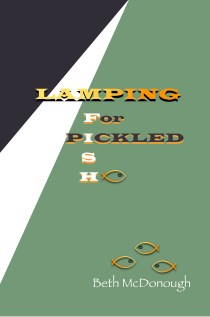
LampingForPickledFish cover


Marmalade

Seville bright, this morning’s sun grins,
rolls her confident complement
against January skies. Let me zest

what I can, then knife through
fluff thickened pith, to score
an acidic aroma, studded in pips.

I finger out segments, let nip
juices loch onto boards then cut;
need to keep this essence, not slight

that necessary sharp under sicken-sweet
covers. A season keens, pierces high
through any resistance of frost.


In all the wrong places
 
Afraid, I anticipated him – reckoned
killer boxes in the owner’s shed. I sensed
that macchja dense with his lives, head-rattled

all those words he’d claimed – scratch
scuttle, rustle, scurry, gnaw. He glutted
my dark. Nightly, I fretted him,

sifted seeds for scat. On the lane’s camber
I tensed, stared riddles at stink-wide
bins for humped moves. No shadow shot

from flag leaf drains. I detected no presence
in dykes. No quick through briar thicks. None. I
opened myself to planets and stars. There –
 
Rat, sleek along telegraph wires,
cork oak to cork oak, smooth
on summer low cables. Linear acrobat.

Previously published in The Scores


Peloton Mallorca, 2018

All hairpin legs, a sweat of serious cyclists,
clackers on stone. Venting over-shoulder shouts,
they’re intent on giant beers. And maybe cake.

In a synchronised de-helmet,
paper-bag faces, screwed hard at sun,
crumple further, seek the bar’s shade.

Now hear how these men
have conquered mountains, powered up just
by their fine-tuned unfettered strength

and some of those particularly fantastic
plastic-wrapped chemical snacks,
sixty rafts of fortified water. And

subtle adjustments to saddles,
minutely engineered accoutrements, then
lovingly curtailed dérailleurs…

and tiny fixed screens to tot up points,
compare the gradients’ percentages,
profile difficulties of hills. With stars.

Most of all, credit to that Vaseline
honeyed thick on unsunned parts
and regularly reapplied.

And those logos; tattooed really large
on blister eye bright Lycra, which now peels
thrillingly from over-greasy bits.

Add in their greatest near-misses –
old ice-cream lorries, atrociously
heading for Soller. Or what about

that rosary-counting pilgrim string
the team almost took out entirely
on a bend at the outskirts of Lluc?

Our natural heroes, who’ve had to pedal so fast
past all the Tramuntana’s high wonders.
Thank heaven their exploits are all Strava’d now.

They need that beer, that cushioned-up seat
and chunk of the cafe’s apricot cake
as they re-learn how to walk.

Previously published in Gutter


We need a name for what we want

Not quite Italian – their older, closer
Mezzogiorno tongue trips out some word
for those fierce greens fat turnips sprout.

Waiting for winter’s greedy sheep
and now the trugs of careful cooks – fat roots
turn up in lines on the hairst’s lost field.

My Paesano friends don’t understand
why Scots will stew that lumpen fleshy bit
of turnip, swede, this misshapen neep

but ignore its freshing shoots, bright
in nipping leaves. Rapine keen enough
for hand-formed orecchietti.

A passing farming man can’t quite believe
his own ears at their risked request.
He just laughs, perplexed. They’re welcome

to walk his land, for however long
they want, fill their tucked-in bags
enjoy whatever they covet and glean.

Previously published in Causeway


Beth McDonough trained in Silversmithing and Jewellery at Glasgow School of Art, and taught Art in various sectors for many years. Approaching her half century, she returned to Dundee University to take an M.Litt in Writing Study and Practice. Her poetry is published in many journals and anthologies, and in 2016,  with Ruth Aylett, she wrote a poetry duet pamphlet, Handfast (published by Mother’s Milk Books). Her work has been placed in several competitions, including those held by the John Clare Society,  YES Festival, MMB, Compound Competition at Cheltenham Festival. Her work won first prize in the Off the Stanza Competition 2017, and in 2019, her poem ‘Samphire’ won first prize in the Science Poem Competition, held by St Hilda’s College, Oxford. She reviews for DURA, and was poetry editor there for five years. She produces the small magazine Firth, and Between 2014 and 2016, she was inaugural Writer in Residence at Dundee Contemporary Arts. Currently a Trustee of Ochil Tower School, she is a huge supporter of the Camphill Movement.

Lamping For Pickled Fish is available from the 4Word website.
June Righelito – The Little Dancer – Rodney Wood

June Righelito – The Little Dancer

June Righelito is a tired fourteen year old ballet dancer stuck in the 4th position. Chin out, shoulders back & heels aligned in his dark, cold & filthy studio.

Instead of a uniform of gold or yellow she’s dressed in a threadbare bodice, tutu, silk slippers & stockings.

She’s tense, scared that Degas will abandon her & she’ll disappear into poverty & prostitution even though he calls her his goddess, his muse.

She likes to think he’ll give her a bit of money & when she leaves the Paris Opera she’ll spend time clumping round a little garden & singing in the evening as she watches the sun slide from the sky.

She’d like to think that but knows artists are stingy old buggers but she sees a bright future where misery lit & experience are all the rage.


Rodney Wood worked in London and Guildford. His poems have appeared recently in The High WindowOrbis, Magma (where he was Selected Poet in the deaf issue) and Envoi. His debut pamphlet, Dante Called You Beatrice , appeared in 2017. You can find more information about Rodney and his work at rodneywoodpoet.wordpress.com

The Deadest – Karen Little (kazvina)

The Deadest

I appreciate truth and new beginnings; I’m happy
to go off the rails. I seldom treat myself
to the hard stuff, but let mundane tasks pile up
while writing or drawing over midday pints
of Long Man, Long Blonde; light golden hops.

I’m in the deadest pub; three pints down. At the next
table she unfurls, stretches towards me; slides onto
the seat opposite mine. I shuffle salt and pepper like an
incompetent magician, consider how long it’s been since
I was seduced by a woman. I want to speed towards

the finish line, but she makes every word a luxury. In my
head glitter balls spin, platform shoes stomp
the night away in an outbreak of seventies
flares and velvet jackets. I never expected love letters,
just letters of resignation and exasperation at my greed.


Karen Little (kazvina) has exhibited her art internationally, and is widely published as a writer in the UK and further afield. Her latest publication is the illustrated pamphlet, Dissecting an Artist (2019) with The Black Light Engine Room Press.

Quantum Sheep – Emma Simon

Quantum Sheep

We’re the uncounted ones, grazing
ever expanding fields of dark matter
night after night.

Woolly ruminants. We chew the cud
of dreams, regurgitate all sense and logic
within our various stomachs.

Lozenge-like eyes that slowly blink.
Fleeces nebulous as vapour in a cloud,
our knees are pretty springy.

Sheep merges into sheep, huddled
in sleepless flocks through sleet, through fog.
Always on the verge of being lost.

We follow one another over fences,
wave after wave of us, sub particles
of imagination, waiting to be discovered.


Emma Simon’s has written two pamphlets, Dragonish, which was published by The Emma Press in 2017, and The Odds, which will be published by Smith Doorstop in early 2020. Her poems have appeared in numerous anthologies and magazines and she has won both the Prole Laureate and Ver Poets prize.
She can be found @SimpleSimonEmma on Twitter

Curtains – Julian Dobson

Curtains

Come over, William, you should take a gander
at my curtains. Check out their thinning
slightly off the centre; the way they fail
to join up in the middle; their boring grey-green
pattern even duller since they’ve hung there
nigh on twenty years. I know your magic

with the fabric. I’ve seen your curling leaves,
unfurling flowers, your cheeky strawberry thief.
I’ve seen the prices they command. So much
for socialism: I’ve been priced out. But
I can do appreciation. So, comrade – if I may –
could you pop over, sample my sloe gin, bring

some news from nowhere? I’m thinking you can help,
because I want to make this room a place
of wonder. Something a visitor might see
and be transported, but not envious. Stirring
like a banner, but more subtle. Earthier, more rooted.
I’m imagining borlotti beans. Let them inspire you.


Julian Dobson lives in Sheffield. His poems have appeared in publications including Magma, Under the Radar, and Acumen, and on a bus in Guernsey.

Leveret – Jonathan Humble

Leveret (after Carolyn Jess-Cooke)

Forty weeks I wondered what would happen.
Bought a tiny cardigan while waiting,
embroidered with some meadow hares in sunshine
and wee blue shoes that you would never wear.

With little witchy hand you grasped my finger,
your body wrapped in heirloom knitted cloth,
each breath I watched and worried in the pauses
and worried as within the sling I held you.

The dandelions spoke your name in secret,
it drifted with the seeds upon a breeze
to leverets that hid among the sweet grass
who saved a place of safety from the foxes.

While in the meadow, hares lay still and quiet,
I walked abroad among a crowd of strangers,
each eye with threat or hidden malice watching,
and as you slept, I’d slay the beasts and dragons.

I walked on broken glass, endured the lightning
and carried you one last time in the autumn,
until with curtains closed amid the silence,
I placed the hares and wee blue shoes in cotton.


Jonathan Humble is a teacher in Cumbria. His poems have appeared in a number of anthologies and other publications online and in print. A collection of his work, Fledge, will be published by Maytree Press in the summer of 2020