The Beekeeper’s Wife – Cheryl Pearson

The Beekeeper’s Wife

They fuzz him into loveliness.
A roving gold,
like dark water strummed by light.
The liquid sun
of honey on the sill, all morning
strained
through glass.

It is out there he is most alive.
In the stilled green, the razed grass.
It is out there he thrills
in the centre of his silence.
His beard’s dazzle
and stitch, the endless hum
of the swarm.

Only the bees fly in his garden.
The laundry waves
white flags from the yard.

In bee-heaven, his is the shape
they make. Bringer
of combs and sweetenings,
milk-smelling God –

I tend the hollyhocks,
stroke barks back
into the dog.


Cheryl Pearson lives in Manchester. Her poems have appeared in publications including The Guardian, Southword, Under The Radar, The High Window, and Poetry NorthWest. Her first full poetry collection, “Oysterlight”, was published by Pindrop Press in March 2017.
Author page: http://www.pindroppress.com/poets/Cheryl%20Pearson.html
Twitter:          https://twitter.com/cherylpea

dealing with loss, ways & means of – Alex Reed

dealing with loss, ways & means of

yell slippin’ & a slidin’
shake to the rhythm
paint biba on your eyes
bungee jump    kayak
go to Hawaii    swallow peyote
down mexico way
catwalk in paris
produce grime & trap
create a virus
to eradicate google
do no evil
pray for salvation
handle snakes
undergo trepanation
reanimate bones
with magical thinking
follow the teaching
of madame blavatsky
discard all secrets
except for one
build a shrine
to elizabeth montgomery
play tenor sax
like pharaoh sanders
marry grace slick
revive the counter culture
become inspirational
embark on a lecture tour
about the world that’s coming
lament for the children
& the world they’ve been given
collect zane grey
smoke marlboro   carry a lasso
say ‘shoot’ when taken by surprise
study string theory   live underwater
build a spaceship with boxes
visit new worlds of your own invention
tell fortunes   see mysterious strangers
crack jokes in northern clubs
move to the south
& vote tory
admonish the voices
lie with another
collect mustard seeds from the houses
of those who have never known loss


Alex Reed is a poet who lives in Northumberland. He is currently studying for an MA
in Writing Poetry.
Alex’s first pamphlet A career in accompaniment was published in 2016 by V. Press
(http://vpresspoetry.blogspot.co.uk)

Featured Publication – You’ve never seen a doomsday like it by Kate Garrett

Our featured publication for September is You’ve never seen a doomsday like it by Kate Garrett, published by Indigo Dreams Publishing.

These are poems about surviving doomsdays. People use the word doomsday to describe the apocalypse, and apocalypse simply means ‘an uncovering of knowledge’. Every life has its share of apocalyptic moments—not only great catastrophes, but also small secret revelations, and surprise twists of good fortune as well. They leave you with lessons learned, and stories to tell.
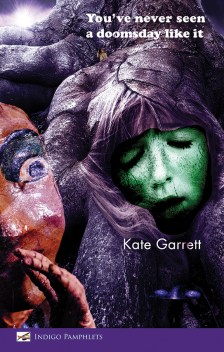
 

9781910834558


You’ve never seen a doomsday like it

He opens the car door for two sweat-and-dirt sculpted
children with ten cent hope – their earth-scent rising
as they root through decades of leftovers, synthetic dreams
once resting on every child’s lips: Smurfs, Garfield, He-Man.

My life at bargain prices, in stasis, this millennial cusp.

An askew Rockwell: the boy and girl treasure hunting
as the July sun makes toffee of the driveway, holds itself
multiplied in each cell of each husk of the rows of green corn
along the road from here to the village.

He asks where I’m going.
 
London, I say, the one in England, not Ohio. His face
doesn’t darken or cloud the way they say faces do;
his eyes stay the same blue when he says I am right
to get out. Either get away or load your gun. This year
 
2000 isn’t going to be pretty. These cornfields will burn.
Houses will be searched, he says, and I’ll be dragged away
like the rest. And he’s going to get his wife and kids
and keep driving. But you get on that plane,

he says, don’t come back –

my life spread out on folding tables between us,
the man laying down five American dollars for pieces
of my childhood; five American dollars
I will change to pounds sterling, while they’re
still worth something, while we have the choice.
 

An august sacrament

The sun lowered itself into our six o’clock
armchair, blushing cream walls to the tune
of Dionysus’s blood, your faith between
my ribs chanting thanks to God for the static
under fingernails

and when the same sun has gone tortoise-slow
and quiet through the ground beneath us
the breeze that didn’t blow today transforms
a moonless night into myth – a remark thrown into shape:
it’s summer, these things happen.

I know
you would dance through
blackthorn if I asked.

You know
I try to believe
in empires, effigies.


They say three is the magic number

I. Vows

We sealed the cusp of winter
with wine and a kiss – our lips on the rim
of each glass purging scars; your voice
carried promises across a room in front
of your God and our friends; my tongue
traced the arc of our story: from a damp
night in June to trading silver rings
in a dying afternoon, daring the dark.

II. Prayers

It’s said All Hallows’ Eve is when
the barrier between two worlds thins out
lets all sorts through – spirits, demons, ghosts.
I’d whispered my own brand of prayer
all autumn long: she could claim her place
after the dress was worn, after dancing and relief
from the ache in my feet, after the wine flowed to a stop.

In the Samhain dark, just barely wed, we married
flesh and soul between midnight and the witching hour,
arms and legs woven together – laid out as kindling
on a bonfire bed, licking flames.

And if dimensions met that night
beyond some lifted veil
while our bodies were inseparable –
who can say which action cast the spell?

III. Completion

November soon brought a sadness, a sickness.
Maybe it was too much drink,
maybe a bleed was on the way,
or maybe after the celebrations
we should expect this comedown
under bare trees, steel clouds.

With the third week came exhaustion
and two pink lines
and I understood everything.


Previous publication credits for the poems are Prole, Melancholy Hyperbole, and The Black Light Engine Room Literary Magazine, respectively.

Kate Garrett’s poetry has been widely published, nominated for a Pushcart Prize, and longlisted for a 2016 Saboteur Award. She is also the founding editor of Three Drops Press and Picaroon Poetry. Kate lives in Sheffield with her husband and four children. Twitter – @mskateybelle

More information on You’ve never seen a doomsday like it – and details of how to purchase a copy –  can be found on the Indigo Dreams Publishing website.
That number – Matthew Stewart

That number

I disembark
from any plane
or lock the door
in another hotel
or hug the bed
on getting home

and fingers reach
for that number
until they shrink
into a sudden fist
as if hoping
I won’t notice.


Matthew Stewart works in the Spanish wine trade and lives between Extremadura and West Sussex. Following two pamphlets with HappenStance Press, his first full collection, The Knives of Villalejo, is due out from Eyewear Books in June. He blogs at http://roguestrands.blogspot.com

The shady part – Elizabeth Gibson

The shady part

Here we are in the shady part of town,
where the old city has ended with its
stone walls and tourists and instead
there are tall trees with green leaves
and yes, they give us shade and cool
our dogs, too, as they lie resting and
barking at those who step around us,
frowning. We are happy to be shady.

Come pay us a visit with your mother,
who said we were sketchy. Watch us
be drawn and painted in, see my love
with her soft neck and perfect limbs
being traced by the great hand of the
twilight, by the keen artist’s eye of a
rising moon. Tell your mother that if
she opens her mind she too can be art.

So, it is dodgy here. Come at the peak
of night, when the earth and street are
alive and we dodge each other as bats,
fluttering, dancing in circles, delicate
and brave. Here we are in the iffy part
of town, where every moment is an if,
and a then, and a future falling before
us. Please. I want you to see it. Come.


Elizabeth Gibson’s work has appeared in Far Off Places, London Journal of Fiction, Severine, Ink, Sweat & Tears, Picaroon Poetry, The Fat Damsel and The Poetry Shed. She edits Foxglove Journal and the Word Life section of Now Then Manchester.
Twitter: @Grizonne
Facebook: https://www.facebook.com/ElizabethGibsonWriterPoet
Blog: http://elizabethgibsonwriter.blogspot.co.uk.

Beads – Louisa Campbell

Beads

For Kate

The things she said
and what she didn’t
pulled me two hundred miles to meet her –
kindness between the lines,
shared tears, understanding.

We said we’d meet in the hotel lobby:
vast; wall to wall glass;
swishing steel lift doors;
reception desk, indifferent.
I stood small at the window and waited.

She arrived, in glamour and timidity,
‘I’m so pleased to meet you…,’ she said
to the floor,
‘but sorry, I’m socially awkward.’
She fiddled with beads in her bracelet.
Silent, side by side,
we looked out.
Grey city streets
and cars and buses and people
went who-knows-where,
who-knows-why.


Louisa Campbell has realised that life is silly, but important, and she is very happy about that. Published here and there, her first pamphlet will be out with Picaroon Poetry in 2018.

Blink – Karen Jane Cannon

Blink

The time the drunk ran straight over a swan,
we banged with fists on bonnet, window glass,
to try to make him stop. He drove along
the shore to Bosham Hoe, between salt marsh
and coast wall strung with weed. It lay just dazed
on sea-spat stones, it’s legs at angles, wings
still beating, heaving like lungs gulping air.
Lurching wildly, it headed out to sea,
the gaggle— white shapes resting, tugging grass
or staring flint-eyed out, across the marsh.
I kept my eyes on it, tried not to blink—
the sun so bright I had no choice. I blinked
and lost track of which one it was—somehow
it seemed to me, I was the one at fault.


Karen Jane Cannon’s poems have appeared in a variety of print and online journals, including Acumen, Orbis, Obsessed with Pipework, The Interpreter’s House, Ink, Sweat & Tears and Popshot. She was commended for The Flambard Poetry Prize 2014.


Housewarming – Tom Sastry

Housewarming

Come to my house. It is empty –
a prison for sounds.

You can mark it with your footsteps,
you can echo in its corners,

there will be time, later, for words.
Before the furniture comes

we can eat pizza from the box
and test out the airbed.

Together, we’ll make a ghost.
Come in person

or in an envelope.
The rules for shoes are as you please

and coats go anywhere
but not yet. Come through here,

share with me this little square of sun,
say how it will be perfect

when I have done
this or that thing which I never will do.

Walk down the hill. Buy macaroons
and a four pint carry-out,

watch clips on my phone.
Just come. Come to my house.

It demands, selfishly,
to be filled

ashamed of its scuffed bones
ashamed of its honest age.

Do not wait. Come while you can.
This house is so beautiful naked

I cannot bear it for long.
Come to my house. It is empty.


Tom Sastry’s debut pamphlet Complicity was published by smith/doorstop in October 2016. It was one of the Poetry School’s Books of the Year for 2016 and is the Poetry Book Society’s pamphlet choice for Spring 2017.

The Sewing Tin – Ali Jones

The Sewing Tin
 
It hid in a drawer,
anchored in darkness,
a landscape borrowed from others,
finding geography in the contours
of buttonholes and zips, few alike,
metallic retorts, sharp spikes slipped
from fabrics unknown.

Who wore the dress,
with flowers in her hair?
Who loosed a pin
beneath the moon’s
bone wide stare?
Who pulled pearls through?
A breadcrumb trail of prizes.

I am looking into
the heart of secrets,
flexing them beneath my fingers,
prying their mechanisms;
no blood on my hands,
hanging stitches from the past;
the dead pricking my fingers.


Ali Jones is a teacher and writer, living in Oxford, England. She holds an MA in English, focused on poetry in domestic spaces. She writes and performs on a regular basis.

These Threads are the Singing – Gram Joel Davies

These Threads are the Singing

Your body becomes a tongue
when rain falls, arms agape
you taste popping candy droplets,
a topical confection. Rain to skin
is light to eyes, you see
with every pore. Rain beats

at downed leaves and sagging
blades, thrashes twigs to pulp
and saturates bark till each surrenders
Assam swirls, tendrils of clove,
and fingers of crushed rosemary:
lizard-licks to your nostrils.

The wept joys of reunion, rivulets
pour, wrap seams, silver-cocoon
your limbs and neck, charge you
like coalesced lightning.
These threads are the singing
of nerves. When rain falls,

every puddle, every street lamp,
every windowed eave disintegrates
into a scintillating dance of atoms,
the world is microscopically undone
but remade. Every ricocheting drop
pounds its bass-pulse in your ears,
unabating arteries, thudding womb.

You breathe like rain, open arms
and legs and mouth and skin
to rain – the curse of being
melts from you in torrents –
you become again the stuff
of motion, surfs and plasmic
hearts of solar systems. Suns.


Gram Joel Davies lives in Devon. His collection Bolt Down This Earth is published by V. Press. See http://gramjoeldavies.uk to find out more.