Featured Publication – Dressing for the Afterlife by Maria Taylor

Our featured publication for November is Dressing for the Afterlife by Maria Taylor, published by Nine Arches Press.

Dressing for the Afterlife is a diamond-tough and tender second collection of poems from
British Cypriot poet Maria Taylor, which explores love, life, and how we adapt to the passage of time. From the steely glamour of silent film-star goddesses to moonlit seasons and the ghosts of other possible, parallel lives, these poems shimmy and glimmer bittersweet with humour and brio, as Taylor conjures afresh a world where Joan Crawford feistily simmers and James Bond’s modern incarnation is mistaken for an illicit lover.

Consistently crisp and vivid, these poems examine motherhood, heritage and inheritance,
finding stories woven in girlhood’s faltering dance-steps, the thrum of the sewing-machine at the end-days of the rag trade, or the fizz and bubble of a chip-shop fryer. And throughout, breaking through, is the sense of women finding their wings and taking flight – “and her wings, what wings she has” – as Taylor’s own poems soar and defiantly choose their own adventures.

‘Maria Taylor’s new collection is exhilaratingly bold. These imaginative poems strike at the edges of form and emotional experience to uncover glittering seams: ‘Winter made me a Wall-Street crash’ announces one speaker while another finds herself ‘ice-skating / into someone else’s life’. They are consistently surprising, a horse revealed as Dustin Hoffman, a married woman irritated at discovering Daniel Craig in her bed. It’s also a beautifully structured book, the film stars who people its pages forming a cohesive gossipy backdrop. By turns hilarious and stirring, Dressing for the Afterlife is a cinematic gathering I know I’ll replay again and again.‘ John McCullough

‘Taylor’s art is surefooted, with a quiet command of line length, a gift for choosing the right detail to illuminate her slyly weighty subject matter and an unsentimental but affecting directness of address. Her poems are firmly rooted in the day-to-day complexities of familial ties and duties, but her extravagantly vagrant thought paths lure us on to follow fancy into unsettling and exhilarating territory.’ Kathy Pimlott

I Began the Twenty-Twenties as a Silent Film Goddess

On the first of January I threw away my Smartphone
and wrote a letter to my beau in swirling ink.
I bobbed my hair, wore a cloche hat and shimmied
right into town for Juleps. I became Clara.
I became Louise. When I became a vamp, the boys
fell dead at my feet, I threw petals over their heads.
I dined on prosperity sandwiches and sidecars,
leaving restaurants with a sugar-rimmed mouth.
In summer I was a night-blooming flower.
By autumn I was a hangover. Winter made me
a Wall-Street Crash. Talking pictures were my ruin.
At last I had a voice but no-one wanted to hear.
Forgotten sisters. Oh Vilma, oh Norma, oh Mae.
A musty headdress of peacock feathers. Defiant silence.

She Ran

I took up running when I turned forty.
I opened my front door and started running
down a filthy jitty and past my parents’ flat.
I ran through every town in which I’d ever lived.
I ran past all my exes, even a few crushes
who sipped mochas and wore dark glasses.
I ran in a wedding dress through scattered confetti
and was cheered by the cast of Star Wars.
I ran through the screaming wind, rain and cloud.
I ran through my mother’s village and flew past
armed soldiers at the Checkpoint. I ran past
my grandparents and Bappou’s mangy goats
with their mad eyes and scaled yellow teeth.
I ran straight through Oxford and Cambridge,
didn’t stop. I saw a naked man in Piccadilly Gardens.
I ran through high school and behind the gym
where gothy teens smoked and necked each other.
I passed an anxious mother pushing a pram
and a baby that kept throwing out her doll.
Seasons changed; summer turned into autumn,
I couldn’t get as far as I wanted.
The lights changed. My ribs, my flaming heart
and my tired, tired body burned.

Loop

Maybe time moves like a figure of eight,
surging forwards then back on itself.

Light returns from exploded stars.
A grown woman could turn a corner
and see herself crying as a girl.

Newsflash: our world ends again.
The disappearing forests of childhood
disappear again.

……………………………………………The path curves.

It takes the woman back to a dimly-lit bar
where she meets the same lover again and again.
She risks everything once more.

They’ve already met
before they’ve said a word.

Unfinished Business

Like the ghost who never realised
he was dead, or the unending record
stuck in a groove, or the comedian
who forgot the punchline, or the bud
spoiled by frost, or the last Rolo,
or the half-painted living room,
or Beethoven’s draft of his tenth
chucked out by the cleaner,
or the bottle of fizz never opened
for a special day, or the rainy day
that rained all year. Who’s sadder?
The man waiting at the bar,
or the woman who won’t walk in?

Previously published in The North

Maria Taylor is a British Cypriot poet who has been highly commended in the Forward Prizes for Poetry 2020. Her poetry has been published in Magma and The Rialto, among other publications. Her latest collection Dressing for the Afterlife, is out with Nine Arches Press.

Dressing for the Afterlife is available to purchase from the Nine Arches Press website.
Doll – Elizabeth Barrett

Doll

The clairvoyant says she can see my daughter
on a train by a lake somewhere in Africa.
When I was seven I dreamed about that train.
The minister looked at me when he told us
not to nurse our gifts, that we must lay them
on the floor. The steel cross on the wall
glinted in the mean north light as I lowered
Rosebud slowly. I had chosen a less-loved doll
for the Mission in Africa but mum had told me:
Think again. God wants us to give what we love best.
I can see myself sitting still, head bowed over
my best doll, dressed in her lightest cotton frock
for a train ride in hot sun. I try to picture her
by the edge of a lake. What is she wearing? I say.

Elizabeth’s collections include A Dart of Green and Blue (Arc Publications, 2010), The Bat Detector (Wrecking Ball Press, 2007) and Walking on Tiptoe (Staple First Editions, 1998). She lives in Sheffield where she works as a university lecturer in education. 

Politics and Protest in the New Normal – Oz Hardwick

Politics and Protest in the New Normal

Spontaneous combustion is just. a part of the new normal.
Passers-by, postal. workers,. newsreaders:. anyone can. go
at. any..moment,. and..it’s. no. longer. a. surprise.. It’s..an
inconvenience, of course,. if you stay in. for a supermarket
delivery which. doesn’t arrive,. and. days later. you. pass. a
looted van with a blackened cab;. and when you. finally get
through. to..the. helpline. to. claim..a.. refund,..thestock
apologies are interrupted. by a whoosh and crackle, .before
you’re redirected to hold music. .There are. demonstrations
on. the. site. of. Pudding. Lane;.flashpoint.mobs. gathering
against government guidance, with no demands, just petrol
and homemade. explosives,. hot breath scorching the. faces
of police equipped with nothing. but stone, flint, and damp
powder.. Ministers. and. experts recommend.. spending as
much. time. as possible. under. water.. though. they. stop
short of formalising advice into rules – and. I for .one. have
placed a tin. bath .in every room.. I often hear voices. as. if
from far away,. but I can never make out the words, and. by
the time. my ears pop. above the surface,. there is .nothing
but silence and the smell of smoke.

Oz Hardwick’s a work has been published and performed internationally in and on diverse media. His chapbook Learning to Have Lost (Canberra: IPSI, 2018) won the 2019 Rubery International Book Award for poetry, and has been followed by The Lithium Codex (Clevedon: Hedgehog, 2019) and Wolf Planet (Clevedon: Hedgehog, 2020). 

Measurements – Stephen Bone

Measurements

Bold regency stripe
gave way to a cabbage rose
extravaganza,

which in turn hid
a tangle of fifties’
geometrics.

Our arms aching
as we scraped back
the decades,

with their buried clues,
until at last, exhausted,
we exposed the final layer

and the faint but readable
name of Ben, his height and age
written out in blue crayon

each third of June, until
after nineteen-forty, reaching
five foot five, tall for ten,

his measurements
stop their climb up
the sickly yellow wall.

Stephen Bone’s latest pamphlet, Plainsong ( Indigo Dreams ) appeared in 2018. A micro-pamphlet due from Hedgehog Press in 2020. Most recent work in magazines include, Agenda online, Black Bough Poetry, Finished Creatures, London grip, Morphrog, Shotglass, The Frogmore Papers.

Ditches – Jennie Farley

Ditches

She has no need to sleep in ditches.
There’s a warm bed waiting at home,
Ovaltine and slippers.

There’s a husband called Stan
who does the washing up, Nobby the dog,
and a blue-and-yellow budgie.

Her friends have smiling faces,
wear flowery frocks from Boden,
and hug each other every time they meet.

But she has a cat called Satan
and a pet crow black
as the blackest night.

She wears a tattered skirt,
and dances barefoot on the forest floor
with a red-haired slattern.

Jennie Farley is a published poet, workshop leader and teacher living in Cheltenham.
Her work has featured in many magazines and been performed at festivals. Her first
collection was Her Grandmother Skating (Indigo Dreams Publishing 2016) followed by
Hex (IDP 20128). She founded and runs NewBohemians@CharltonKings an arts club
providing poetry, performance, music throughout the year.
Website jenniefarleypoetry.wordpress.com

That Little More – Tom Kelly

That Little More

He is in my arms 
sun settling through trees 
flickering carpet 
mottling his face 
still sleeping.

My heart has been dead 
shed tears, nearly broken me 
but at this moment 
everything held 
fixed, settled 
the moment when love gives 
that little more.

Tom Kelly is a writer from the north-east of England. This Small Patch, his
ninth poetry collection has recently been published and re-printed by Red
Squirrel Press who also published his short story collection Behind the Wall.

Vitamin C – Jen Emery

Vitamin C

Already halfway out the door, you turn,
almost as an afterthought, and give me
clementines – To wish you better, you say.
Just like old times, I offer the closing door.
I feel their weight, the scratchy red net, the fruit
straining and bouncing, mad and happy. I tear
the net with my teeth, take the first fruit, pierce
the tight skin with my thumbnail, and feel the release,
the gust of sweet citrus scent. I pull
the segments apart with a certain care, and place them
moon by moon round the rim of a white plate.
I lift noon to my lips and bite the firm,
floral flesh. I eat around the plate
like a meditation, watching the spaces between
the segments widen. Wait. Then take
another fruit and begin again. All day
I eat, until my hands are sticky, nails stained,
my tongue numb, the red net slack and spent.
The pile of rind is fragrant and disheveled
and it seems to me that this, at last, is hope –
improbably pert and shining, and smelling like clementines.

Jen Emery writes poems, business books and shopping lists. She lives in London with four unruly children and a dog, and looks after people and culture for a global design and engineering firm. She thinks, writes and speaks, usually in that order, at www.jenemery.com

The Chiropodist’s Wife – Emma Halliday

The Chiropodist’s Wife

Recording commenced, 10.09am

My husband prefers to not be disturbed when he’s working the role requires concentration
he mostly attends the older generation but children need his attention school changing
rooms are a filthy breeding ground we converted the bedroom at the back of the house
when he qualified our eldest used to sleep there ……I remember the client an obstinate
case of athlete’s foot I made mum a cup of tea in the kitchen she was glad to have ten
minutes’ peace talked incessantly about her daughter’s gymnastic trophies they’re better
behaved when the parents stay put (Displays Exhibit A) ….They were ordered online
breathable, not fabric individually wrapped to be stuck in the elbow crease he’s
attentive, you seechecking in case of allergic reactions ……he put it where? ……..I suppose
the skin is sensitive there, as well ……I chose the Disney design …….she could have gone
upstairs anytime

Recording paused, 10.25am

Emma Halliday is an emerging writer based in north west England. Most recently, her health themed poetry was commended by The Hippocrates Prize for Poetry and Medicine and appeared in this year’s NHS anthology – ‘These Are The Hands’. www.dontwriteinthemargin.com

Charmed – Robert Nisbet

Charmed

He seems to be circled around this morning
with the light, almost a halo,
of a muted but insistent joy.

He has walked from the Lane to the corner shop
and has been, as ever, charming, but today
his joviality rings him round like an amulet.

This is ridiculous, he thinks. He might as well
have harps around him, dulcimers, like the man
in the Coleridge poem. Yesterday .. listen ..

.. You do not need any further treatment ..

He can think now of the daybreaks in store
and the Eastern suns on the mountains.

Robert Nisbet is a Welsh poet and sometime creative writing tutor at Trinity College, Carmarthen, who has published widely in Britain and the USA. He is a Pushcart Prize nominee for 2020. 

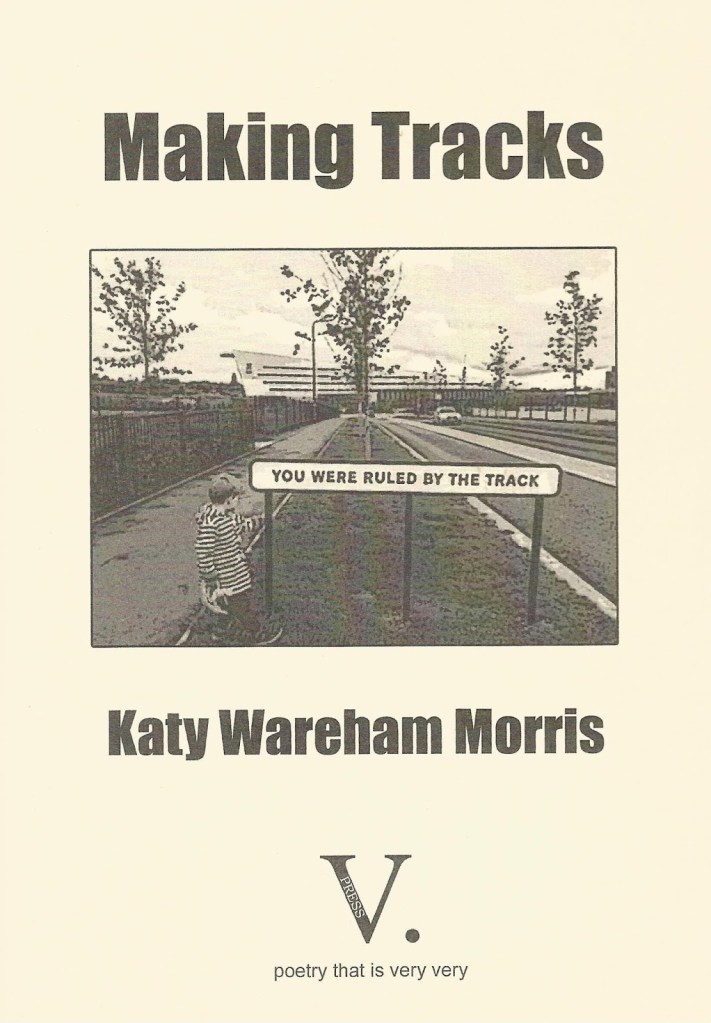
Featured Publication – Making Tracks by Katy Wareham Morris

Our featured publication for October is Making Tracks by Katy Wareham Morris, published by V. Press.

From the very first page of this pamphlet, the reader encounters a voice which is entirely new. Within this pamphlet we find interrogations of masculinity, class, manual labour, what is and isn’t inherited through different generations and, most excitingly, see how these different preoccupations can be refracted and reflected through language and the line. As there should be when searching for new ways to contemplate tradition, a fresh type of experimentation with language, its spacial arrangement and its breath, is given to the reader, but always with a solid and concrete centre of people and place. A balance is struck between the heart, and the search for a language, scientific or natural, which might be able to fully represent it. Poems such as ‘You and Him: A Venn Diagram’ give us a visual language for exploring the pamphlet’s themes, and the pamphlet as a whole brings together the insertion of the urban and natural, the historical and the contemporary. An exciting new pamphlet from a poet doing important new things with the art.‘ Andrew McMillan

Making Tracks uses the texture of language and collaged fragments to celebrate those people who worked at the now defunct Longbridge car factory.  Wareham Morris’s father is the beating heart at the centre of these poems, it’s whose voice we hear, entrusted to her tender keeping.  There is the melancholy of a way of life gone here, but also the love of a day’s work and the satisfaction of a job well done.‘ Helen Ivory

The Heart

St Modwen: “What we are doing is putting the heart back into
Longbridge.

  1. Attractive developments in stunning park-side locations
    for first-time buyers, young families and downsizers
  1. creating inclusive, friendly environments evolving day
    by day
  1. with nearly 100 businesses currently located creating
    3,700 jobs across a variety of sectors since 2007
  1. utilising old industry and new technology, this is a
    unique £300 million project
  1. securing the best training for young people and adults
    with high quality educational establishments
  1. and a flagship youth centre called ‘The Factory’
    offering innovative and creative activities
  1. on a stunning three-acre urban park with free parking
    available for up to three hours
  1. building communities, using the rich heritage while
    looking to the future

9. a stronger, more prosperous

10. place to call home

I say to the kids, whilst we eat our Marks’ sandwich, “This is
where Grandad used to build cars.”

Vehicle Scheduling (Fragment V)

as shells came out of the paint shop painted we’d put the order
on send to the track for trim as shells came out of the paint shop
painted we’d put the order on send to the track for trim stop

for tea walk to the urn fill the pot walk back get the sarnies out
cars come down from the roof no cars to the track cars come
down from the roof no cars to the track track runs out there
ain’t no cars

5 trim tracks 2 copies on the order take 1 copy off send to the
conveyor keep the copy in order of bodies right order right
engine right shell 5 trim tracks 2 copies on the order take 1 copy
off send to the conveyor keep the copy in order of bodies right
order right engine right shell here comes the engine here comes
the body stop

this should be an automatic he got them arse about face bastard
eating sandwiches drinking a pint as shells came out of the
paint shop painted we’d put the order on 5 trim tracks 2 copies
on the order take 1 copy off send to the conveyor send to the
track for trim keep the copy in order of bodies right order right
engine eating sandwiches drinking a pint as shells came out of
the paint shop painted we’d put the order on 5 trim tracks 2
copies on the order take 1 copy off send to the conveyor send
to the track for trim keep the copy in order of bodies right
order right engine stop

dispute meeting ain’t solved it (planned it?) right we’re off

Terrible Really

They were bloodying fists all the time,
you kept your cool, though your heart was
still beating all the time, you were all fighting.
People wouldn’t cope today, they’d crack up –

…………..there one day and then gone
…………..to the funny farm. You never thought,
…………..you never talked,
…………..but the pressure –

…………..blokes did crack, blokes didn’t cope.
…………..Your bloodied heart kept beating,
…………..you were all fighting,
…………..never talked.

Dog eat dog: you admit you ate anyone because
you wouldn’t go under or take the flack.
You had to keep fighting, the pressure,
you couldn’t go under.

It wasn’t all doom and gloom:
the Olympics, darts and cricket in the summer;
like the Wolf of Wall Street, you had men on your coattails.

One day a bloke, a good bloke
with only one son,
came to you and said he needed to leave.
He needed to get to Hillsborough, he needed to try
and find his son at Hillsborough. He came back but his son –
you didn’t let him crack, you didn’t let him go under.
You wouldn’t eat him, your bloodied heart
didn’t mind when he cried.
For a time, it beat and bled for both of you.

(re)cord

I can’t promise that this is true
or love or some kind of

or you and me immortalised
by history, writing into time
as if it makes it

I think it already was alive
still is in

more than just a story
it had an end and we

alive, in reality
matching your –

some kind of
can hitch our memory

Katy Wareham Morris is a lecturer in Media and Culture at the University of Worcester; she also contributes to the Creative Writing team. She has a particular interest in gender and queer studies, identity politics and digital humanities. Katy is currently working on her PhD research in literary gaming, play and post-queer politics, exploring interactive and innovative forms of digital poetics and their dynamic potentialities. Her debut poetry pamphlet, Inheritance (written with Ruth Stacey, Mother’s Milk Books, 2017), won a Saboteur Award for Best Collaborative Work. Her experimental debut collection, Cutting
the Green Ribbon, was published with Hesterglock Press in 2018.

Making Tracks is available to purchase from the V. Press website.