The hill above the town – Jon Alex Miller

The hill above the town

I ask not in sorrow…” – Czeslaw Milosz

We were walking on the hill above the town, 
two of us, after the pubs shut

when a quick bright slash ripped across the sky. 
Only I saw it – he was facing away

but we both then heard an owl’s call, very close, 
as if in exclamation.

That was thirty years ago. Now all 
are gone: the meteor, the exclamation,
my brother. I say this not in grief, 
more bewilderment.

Jon Alex Miller lives in London with his husband and dog. He has poems published in Magma, the Haiku Quarterly and the Hyacinth Review. He works with big businesses on climate change and social justice. @JonMillerXX

Mistake – Paul Stephenson

Mistake

Gone one on leaving.
We went for lunch.
Some random Mexican.
No idea how we managed
refried beans and guacamole.

She’d wanted to see him,
come over to see him,
so I took her to see him.
It had been a fortnight
since I’d first seen him.

Wish I hadn’t arranged it.
Wish we hadn’t gone.
She was in a state and I was
horrified by time,
what two weeks could do.

We talked and we ate.
Even talked about other things.
Then we paid the bill,
and she took the bus
and I took the Tube.

Paul Stephenson has three pamphlets including Selfie with Waterlilies (Paper Swans Press, 2017). He co-curates Poetry in Aldeburgh and lives between Cambridge and Brussels. His debut collection will be published with Carcanet in 2023. Website: paulstep.com / twitter: @stephenson_pj / instagram: paulstep456

Flamenco – William Thompson

Flamenco

After Carmen Amaya

Her clapping hands tune the guitars to fever pitch.
Her boot heel moves as quickly

as a finch’s wing, making a sound like gun fire.
She glides across the plywood stage

then spins with the breath-taking violence
of a horsewhip. Now, she snaps into a slalom

from shoulder blade to hip. She keeps her hands
above her head, arms moving like charmed snakes.

The cameraman pans out. And now your own heart
is tightening: at the drum roll of her feet,

her stern precision, her bull fight with the air,
her brilliance recorded forever in black and white.

William Thompson is a PhD candidate in Creative Writing at the University of Bristol. Born in Cambridgeshire in 1991, his work has appeared widely in journals and anthologies. His debut pamphlet After Clare, is forthcoming with New Walk Editions. 

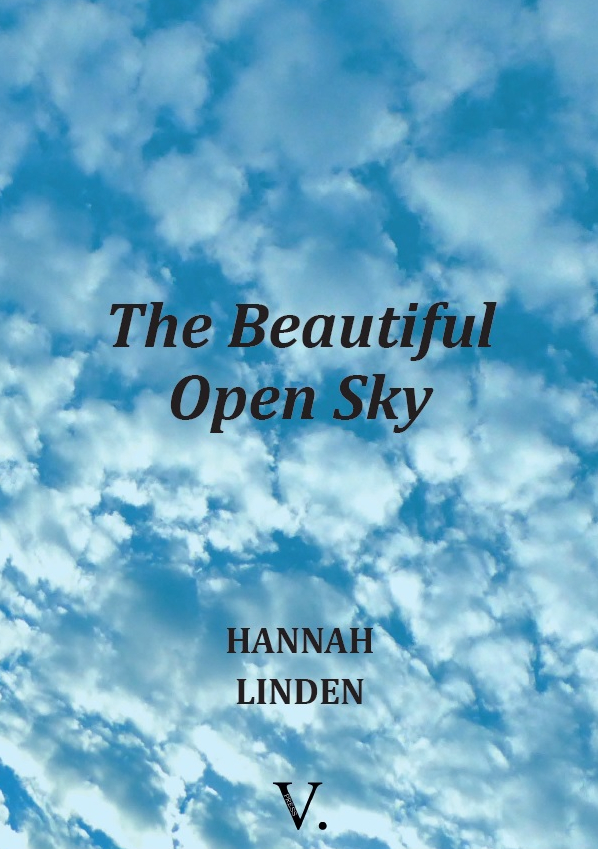
Featured Publication – The Beautiful Open Sky by Hannah Linden

Our featured publication for November and December is The Beautiful Open Sky by Hannah Linden, published by V. Press.

The Beautiful Open Sky opens with an extraordinary run of poems, heartbreaking and precise, about the damage done by a narcissistic mother. As it progresses, the poems accumulate symbols, becoming increasingly phantasmagorical, before the patterns of a new life emerge as if through broken cloud.  It works as a story, direct and emotional; but is also a meditation on how we remember – on the limits of reason and metaphor as ways of understanding the past. This is a fine model for a pamphlet: a focused set of beautiful poems, cunningly arranged, which draw power from each other. A wonderful debut.‘ Tom Sastry

Truths are slippery and sometimes sinister in this stunning exploration of familial relationships by Hannah Linden. It can be hard to know who to trust, or who is parenting whom. But there is beauty here too, and a positivity that shines through despite the odds. Self-reflective and superb, Linden’s use of language is playful and imaginative. I can’t wait to see what she does next.‘ Julia Webb

Childhood

Today the only job I have
is keeping the blackbird quiet. At first,
when she ached, she lay quietly in her box
and everything was simple. I fed her milk-soaked bread,
pretended she was my baby. Being a mother
is easy. I stroked feathers, put scaly toes
between my fingers, felt, at last,
that I belonged.

The bird was lucky. She lived and I took
her to school with me. That was when
the trouble began. The teacher didn’t
understand how to teach a bird.
The blackbird tried to tell the teacher
about flying. She hopped up to the window
and sang to the sky. But the teacher
heard the song as a lie.

An unsinging bird is a heavy load.
I wondered if I’d misunderstood
the instructions. Surely if I was
doing the job right, this wouldn’t
feel so hard. My pockets filled
with feathers and my mouth
was a soft down away from naked
terror. My bare-boneness hollowed.

I was a fragile nest holder longing
for a tree or a gap in the hedgerow.
This was no way to inspire eggs.
The blackbird pecked at the only
bit of me that was still soft, a hidden
underpart of resistance. A hole grew
to the size of an open beak, its song
so sweet the whole sky replied.

Previously published by London Grip

The Cottage in the Wood

Be careful of the stories you keep, my mother said.
Peel back their metaphors and check under their skins
before you put them into your basket.

Mother forgets, sometimes, the basket, the tightness
of its weave, how big its handle. Life was simpler
under lamp-posts. It’s hard to remember

when Mother stopped dropping breadcrumbs.
Only that the birds were angry. After they filled the sky
with loud wings and dark, cloud-heavy shadows, she

stopped looking up or back—closed the track.
And lost became normal. It almost felt
like the cottage in the wood was home.

Siblings were a dream I couldn’t let
myself coddle. Sleep, the rhythm of water that has
nowhere left to fall. Mother was a pool of cave.

The witch my mother had made for me was
a fragment of heat on the scent of gingerbread.
However much I ate, I would never be full.

Previously published by And Other Poems

The Start of the Fire

What is a witch, after all, but the story of a woman
hungry enough for children she’ll do anything to get them.

Is that really what you wanted to hear? Look to your sadness
and see if it is the size of abandonment.

There are many ways to put yourself back into the story.

I am walking well-trodden trails now, 
the banks of the river shored up with broken-down trees.

There has to be a way to keep the edges from falling.

Sometimes you have to let go of the monsters 
from the stories you were told.

Maybe the witch didn’t want children
but just wanted to build something so sweet

it was ridiculous.
Someone was going to bite bits out of it,

eventually.

It’s a pity children see right through to the red-hot oven of us. 
That they have no mercy.

Previously published in Domestic Cherry

Single Mother in Wonderland

I know the rabbits aren’t real, especially the one
always worrying about time. But this is the hole
I fall into when I’m trying to catch the baby.

Oh my poor children. Mothers are supposed to
know where the keys are and which doors
fit. Why are all the other children playing cards?

Please give me a pill that will make me fit into
my house. Inside me is a child and she’s
so much smaller and bigger than she should be.

My children want me to make a proper high tea.
They want to chop off my crazy, worrying head.
They want me to know how

to play the croquet game.
I don’t. I don’t. I don’t.

Hannah Linden is from a Northern working class background but has been based in rural Devon for most of her adult life, where she lives in ramshackle social housing with her two (adult and adult-cusp) children. Despite navigating depression/anxiety she has been published widely. Her most recent awards are 1st prize in the Cafe Writers Open Poetry Competition 2021 and Highly Commended in the Wales Poetry Award 2021. She is working towards her first full collection.


Signed copies of The Beautiful Open Sky are available to purchase from Hannah Linden via direct message on Twitter: @hannahl1n. Unsigned copies are available from the V. Press website.
Jacob’s Ladder – Ed Limb

Jacob’s Ladder

It’s almost impossible to see clouds.  
They’re there, of course, in their flat caps and fluff.

But we hardly ever see them. I mean, 
for their vastness, sheer scale, as monuments,

palaces, leviathan. How can you?  
They’re always there. It’s a useless kind of awe.

But, Christ, if they were alive! They’d be the match  
of gods – proper Lovecraftian stuff.

If they were mountain peaks, they’d thrill the heart.  
If tombs, who could deserve or what age sculpt them?

When they glow in the evening like embers
the earth is ash. When cast in gold at dawn

they seem the host of heaven. Even on days   
like today, when the sky is a loading screen,

they are a marble sea encircling the horizon.   
If we could see them, we’d stop in traffic,

we’d cower or convert. But how can we?  
Why would we? They’re just clouds.

I explain this to my mum on the phone.   
It’s one of several such calls, when the line’s

a little thread holding me together.   
I dip my ankles in her patience, her love,

make myself invulnerable in it and its vastness.   
She updates me on the chickens.

I tell her about my work. And afterwards,
I wonder: could I ever see her love,

really see it, encircling my horizon? But
how could I? Why would I? It’s just mum.

Ed grew up in Nottingham and studied English at university, spending more time in theatres than lectures. He lives in London and writes around his day job. He is glad to have had pieces published in Under the Radar, Dust, Dream Catcher, and Sideways Poetry.

Sophia is Out of My League – Gram Joel Davies

Sophia is Out of My League

I arrived at university but found
the glass had someone’s lips on the brim.

The wine-list was unreachable.
I smuggled the crystal-ware home

and tried to fit a kiss
where she had been.

Although I eavesdrop on tables
I can’t ask her back for discourse.

My shelves have dusty techno
and Dungeons & Dragons figurines.

I should have turned my body
through the sharpener

not learned to hold smoke.
Asthmatic exhalations

rehash my parents’
rejection of right-to-buy.

I turn to say something with shreds
of last year’s set text in my teeth.

..

Gram Joel Davies is a poet in Devon. His collection Bolt Down This Earth (V. Press) was publihsed in 2017. It’s been a while, but he is getting back into writing after training as a counsellor. A recent poem in The Moth marked his return.

everything – Julia Webb

everything

Julia Webb is a writer, poetry mentor/tutor and editor, based in Norwich. Her third collection The Telling was published by Nine Arches Press in May 2022. She is steering editor for Lighthouse – a journal for new writers.

Still Daughter – Sophia Argyris

Still Daughter

My grandmother made things from silver and wool,
made biscuits from flour and peanut butter.

My mother made things from clay and glass, 
from eggs and aubergines, from almonds and words.

I am watching the approaching winter,
growing seedlings at the end of summer,

walking barefoot in the woods, cutting
my feet on twigs and sharp matter

trying to make something from air and water
from rhythms and seasons,

from mornings and evenings, from being a woman, 
still being a daughter.

Sophia Argyris grew up mainly in Scotland and now lives in Oxfordshire. Her poetry has been published in various places including Magma, Prole, Structo and Under the Radar, and is forthcoming in 7th Quarry in 2023. Her short collection “How Do the Parakeets Stay Green?” was published by Indigo Dreams Publishing in 2014.