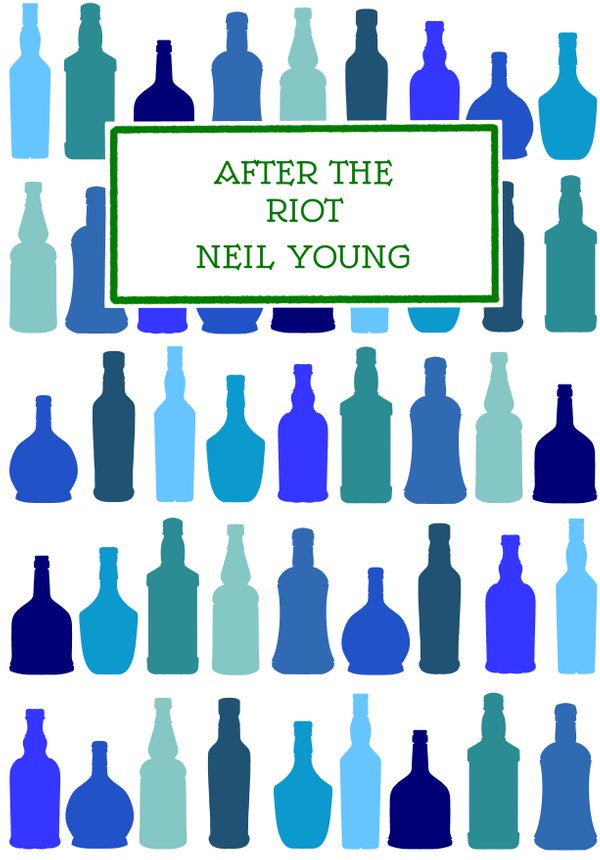
Featured Publication – After the Riot by Neil Young

Our featured publication for September is After the Riot by Neil Young, published by Nine Pens.

After the Riot’ is both elegaic and defiant. The poems begin by revisiting a Belfast doorway where ‘no-one has kicked the carpet dust in forty years’, then open out to explore themes of migration, displacement, war, legacies of violence and loss but – ultimately – regeneration. They unravel instants, or snapshots, as stories, and are acutely concerned with the struggle for memory, amidst myth-making, as our personal and political histories collide.

Neil Young recalls themes with which, you’d hope, our children will find it difficult to connect: war, sectarianism, poverty. I’ve always thought the job of a poet wasn’t to secure sales, workshops or honours but to memorialise their people. Young tells the story of his people frankly, brutally even, but with grace, skill and humanity – love, in fact.” Hugh McMillan.

A socialist poet par excellence. His poems have that rare and authentic quality of the best of folk music” Brian Patten.
Dust

In time…… they all stopped here,
those folk we called our family or made-up clan,
from half-a-half-cousins to uncles of aunts,
sailors and navvies with oversized yarns,
women in floral 60s skirts and head-scarves
who got their bags from the market stalls.
They wiped their feet on the front-door mat,
all their histories passed that spot
then filtered through to the living-room fire
and kitchen thick with tea and talk.
This was my mother’s refuge from Orangedom,
she carried her Dickens hardbacks from Yorkshire to Belfast
as if their touch might be her last thread to a civilised world.
My father – once the latchkey kid – stood on the landing
in dripping overalls when I was born
halfway through his evening shift.
He’d ran three miles in a deluge, swerving cars and buses
from the gasworks to Ballyscillan’s new estate.
Granny Lizzie arrived with a cough that stuck
like knotted rope to her lungs from 1920s TB;
my grandad like a stray dog with his whisky eyes;
his own father in final years, tramping brogues on twisted legs
that once had moved loose-knee across the Somme.
These men who tripped from war to civil war and back –
they palmed their curses onto their daughters and sons.
Here as well the priest-afflicted neighbours sang at new year,
my mother slipped them cake and clothes
in hushed insistence at the door, my brothers
larked with me in Liverpool shirts for our first Kodacolour snap.
And then, as fleet as shadows, they were gone
though they brought all this land’s fierce history to a single spot:
half myth, half real, troublesome and warm,
too proud and fast to grievance, garrulous and thrawn,
god-drunk and heathen, intoxicating with their strange lyric tongue.
I hold them bitter-sweet as a song I did not know I’d memorised
though forty years have passed since anyone kicked the carpet dust
and I am all of that house that now is left.

After the Riot

The teapot still touch-warm from hours before,
slops of leaves in cups and tumblers whisky-wet
where I now wiped my finger, tasted life, that heated life 
that hurried in for refuge through the door.
Ashtrays packed, some butts half-smoked
and cirrus of last night’s smoke where loud hushed talk
was not supposed to stir the little ones upstairs.
Black-stained clothes lay dumped on a chair,
their smell stretched from the front room to back gate
where others had slipped homewards after dark.
While adults slept, I took their empty space
as if enacting my small part in a wordless pact:
I washed the cups and glasses, emptied butts 
and threw the bloodied tissues in the grate.

To the Young Woman Who Wrote Her Number on My Left Thigh on the Nightclub
Stairs in Cushendall, September 1994

If I hadn’t been so hasty to take a shower
I’d’ve called, you would have been in,
I’d’ve have caught the train to Dublin
the next weekend,
we’d have met under Clerys Clock,
you’d have mistaken me briefly
for someone exotic,
introduced me to your five brothers as a friend
you were showing round town.
We’d have inter-railed
and slept on beer-sticky floors,
you’d have fled your horrified parents
so we could share a flat in Camden.
By now we’d have our own
fridge magnet collection,
hate each other,
you’d be blaming me
for the baby out of marriage
that heaped eternal shame
on your god-fearing folks back home,
we’d be getting divorced,
feuding over money and the kid.
Or by some unlikely fluke of luck
one of us might be well-paid,
we’d be making an annual pilgrimage
to Cushdendall
where we’ll get pissed in Johnnie-Joe’s,
you’d make a ritual
of writing on my inner thigh –
or someone else’s thigh,
a young feller’s who skipped the shower
and took the train to Dublin.
I’ll catch you on the rebound.

Grosvenor Square

There was this feller, a dad he was.
Don’t ask me why he was there
but not to protest against war, I’m guessing,
unless a sleeping bairn in a pram was his covert weapon,
because just as the riot broke out and people
were scattering, charging, surging, trampling everywhere
and smoke bombs thickened, flames were rising
and up on the wall of the US embassy three masked
demonstrators were strutting, burning the Stars and Stripes
to the roar and salutes of the crowd, and just
as we could hear the first incoming clatter of hooves
he was right in front of me, lifting the pram.
And me and two women without any prompting
grabbed an end each and hoisted the wean
– still sleeping through the whole shebang –
onto the pavement beside the side-street
and then the dad was shouting, stranded,
so all of us lifted him, he was crowd-surfed
to the edge of the riot, and smiling, laughing, thanking us
as he was planted down with his child, then hurrying off
from the scene. And that was the instant I hunched down low
just in time to miss the shattering glass from the pub windows
and the Robocops as they zig-zagged on the street
and swiped through bodies and smoke;
and it makes me wonder, these many years later,
why it was so easy to lift a small child
backwards in a pram through a riot
when millions, millions of us, couldn’t stop a war.

Neil Young hails from west Belfast (1964 batch) and now lives in north-east Scotland. He worked as a labourer, kitchen porter and stage-hand before becoming a journalist and going on to report from New York post 9/11 to the Gaza Strip. Neil’s publications include Lagan Voices (Scryfa, 2011), The Parting Glass – Fourteen Sonnets (Tapsalteerie, 2016), Jimmy
Cagney’s Long-Lost Kid Half-Brother (Black Light Engine Room, 2017), and Shrapnel (Poetry Salzburg, 2019). A new pamphlet, After the Riot, is forthcoming (Nine Pens, ninepens.co.uk). Neil co-founded The Poets’ Republic magazine and Drunk Muse Press.

After the Riot is available to purchase from the Nine Pens website.

We eat oranges and talk about the nature of truth – Jan Harris

We eat oranges and talk about the nature of truth

I tell you that the orange has the perfect name,
an O to show its shape,
the zing of colour when you think the word.

But you – ever the entomologist – remind me,
if you could see through a honeybee’s eyes
it would look yellowy-green.

You score the zest with a knife –
release the citrus scent of Christmas,
satsumas tucked in stocking toes.

You’re so… traditional, you say, laughing.
I wonder if you’re thinking, old-fashioned,
predictable
, maybe even boring.

To you, it smells of our holiday in Seville,
orange blossom in every street and square.
How we swept home at dawn, petals in our hair.

You cup the orange in your palm,
separate each segment tenderly
as lips might open for a kiss.

I slice my fruit in half and find a sunburst inside,
the radiance of your smile,
a wheel speeding away with us.

Jan Harris’s poems have appeared in various places including Acumen, Envoi, and Poetry Wales. Jan was placed third in the Wales Poetry Award, 2019. Her first collection, Mute Swans on the Cam, was published by Oversteps Books in July 2020.

Walking with Mary Shelley 3. – Louise Warren

Walking with Mary Shelley
3.

Mary is stitched into the middle of me-
as she was stitched into my mother
pulling the pieces of us together pinch tight
we try to squeeze to death the quiet version of ourselves.

Blue silk, forget-me-not, chiffon sky
we unpick her with our nails
as we worry, we fret, we unravel her
with our magenta, our hollyhock, our fogs.

Our deep depressions, our electric storms,
our blackest ink. Mary says-
we are not all content to lie between others,
I am narrative, scrawled in graphite,

little matted furs.
Wetness, hair, birth blood, breast milk,
life, death, silver clasped.
Mary.

.

Louise Warren’s first collection ‘A Child’s Last Picture Book of the Zoo’ won the Cinnamon Press Debut Prize (2012). ‘In the scullery with John Keats’ also published by Cinnamon Press  (2016.) Her latest pamphlet ‘John Dust’  published by V.Press in 2019.

Spirit guide in the bar – Ramona Herdman

Spirit guide in the bar

Watch the drunk the other side of this drink.
She’s the you you’d be if you drank it.
The you you’ve been before. That your dad was.
The you your children would be
if you thou’d them into existence.

She’s smiling at you. She thinks you look
pretty hot, pretty important,
pretty witty, pretty good fun, exactly
the sort of woman who should put down
her book right now and saunter across the bar

with a devastating pick-up line
and a half-conscious back-up line
in the back of her head, to cancel
tomorrow’s inconsequential commitments.

Ramona Herdman’s latest pamphlet, ‘A warm and snouting thing’, is published by The Emma Press. Her previous pamphlet, ‘Bottle’ (HappenStance Press), was a PBS Pamphlet Choice. Ramona lives in Norwich and is a committee member for Café Writers.

Observing the Dark – Joan Johnston

Observing the Dark

One bird’s tick
in the Rowan. ….There,

hear that? …..Wait
for it again

but no….. it’s gone,
tiny and flown.

This sitting on cold stone
looking hard,

listening
to a tree

as if….. by this late vigilance
word would come.

Since 1997 Joan Johnston has published 6 poetry collections and pamphlets. She has been a writer with the homeless, in hospitals, schools, women’s refuges and prisons and she currently teaches Creative Writing on a freelance basis. 

My Monarch – Paul Stephenson

My Monarch

In his gown of white cotton with intricate brocade,
here he lays, collected and regal, my own medieval

………………………King of England

He’d like that, of England, this his adopted country,
lying in a white cotton gown with intricate brocade.

His nose is finer than I recall, cheeks a little sunken.
Hair beneath the chin, like he’s missed a bit shaving.

Up to his chest, a dark purple velvet with gold trim.
He lays here in white cotton, the intricate brocade.

Paul Stephenson has published three pamphlets: Those People (Smith/Doorstop, 2015), The Days that Followed Paris (HappenStance, 2016) and Selfie with Waterlilies (Paper Swans Press, 2017). He as MA in Creative Writing from the Manchester Writing School and co-curates the Poetry in Aldeburgh festival.

Caulk – Julian Dobson

Caulk

I’m smearing white gunge into cracks
again, kidding myself momentarily
that this building need not breathe. It’s best

to use bare fingers, squeeze the silicone
into each hairline crevice, press and smooth. Below,
old ground fails to understand the urge

for regular, unblemished surfaces, skimmed
and sealed, for light to shimmer evenly from walls.
The substrate shuffles. Earth hiccups, itches,

finds more comfortable postures. The house
creaks, settles in response, puts on weight with rain.
We learn its habits, habitats. Let’s call this love.

Julian Dobson lives in Sheffield. His poems have appeared in publications including Magma, Under the Radar, and Acumen, and on a bus in Guernsey.

Hetty’s Room at Hellens Manor – Rebecca Gethin

Hetty’s Room at Hellens Manor

It is a part of virtue to abstain from what we love if it should prove our bane. Hetty Walwyn,
18th century

She was locked in the room
……..a) because she’d run away with a lowly man
………….and no one would ask for her hand.
……..b) because a woman who defied convention
………….should be given shelter but not their freedom.
……..c) because she was deranged with grief and no one had a better idea.

It began with
…………..a) the click of the key in the lock.
…………..b) the gardener thudding a wheelbarrow.
……………….with a squeaky wheel over the cobbles.
…………..c) a terrible row where the parents
……………….couldn’t agree and both thought they’d let her out.

She didn’t know
…………….a) lock-up would last a lifetime.
…………….b) no-one would come even when she rang the bell.
…………….c) if she could have a small fire to warm the room.

She could see
…………..a) a small yard where a robin and a wren sang.
…………..b) the comings and goings of kitchen staff,
……………….tops of heads with bonnets or hats.
…………..c) smoke from chimneys.

Her cell contained
…………..a) a bed, a table and a bell rope.
…………..b) a cupboard to hold her nothings.
…………..c) a roomful of air.

She scratched the sentence on the window
……………a) because no-one listened to her beating on the door.
……………b) to show she was sorry but questioned the meaning of virtue.
……………c) to leave something of herself behind.

Downstairs, guests sometimes heard
……………a) footsteps going back and forth on the wooden boards.
……………b) sounds of crying or screaming and a tolling bell.
……………c) the scratch of her diamond ring across panes of glass,
………………..etching the word she hoped
……………….might release her: Bane, bane, bane.

Note: After an elopement Hetty Walwyn was locked in a room at Hellens Manor at Much Marcle for 30 years. With thanks to Regi Claire for the idea of the form

Rebecca Gethin has written 6 poetry publications. She has been a Hawthornden Fellow and a Poetry School tutor.  Palewell Press published Vanishings in 2020 and Marble recently published Fathom.  She blogs sporadically at www.rebeccagethin.wordpress.com.

Meditations on Anxiety Management – Jinny Fisher

Meditations on Anxiety Management

O woman with the reassuring glasses and bun (Zoom box top right), are you the one with the
evidence? If I make coffee, can we huddle into a private screen, and pretend we’re sharing my
milk? I’m sure you have graphs and analysis to offer in return.

Someone tweeted that the heads look like Muppets and yes, there in the third row are Fozzie
and Cookie Monster. I feel like squeaking Beaker; I need someone to be Animal, so we can all
scream along.

This morning, I inspected my hair for emerging roots. I would prefer a full flaunt of bright
white—better than this rat-crawling-from-a-bag-of-flour. The creature is creeping down my
head for everyone to ogle at the next online event.

I’m fretting about blackfly on my beans. There are so many possible remedies— aluminium
foil around the stalks, vinegar water, even dilute detergent—can I learn to live with them? I
harvest some gnarly pods. Bug juice smears my Marigolds black, and stains the washing water
magenta.

I’m in a box of reinforced glass—I polish the inner surface daily. I have no ICU in my garden.
Dead bodies don’t line up for my tally. Bar charts dance across the meadow and line graphs
hang in tangled clusters from the apple trees. So I seek second-hand data: how far does the
threat travel through the air; what is the best protection for me, my partner and kids; where and
how should I mask?

Bandwidth allowing, next Saturday will be Quiz Night, and I shall wear a bobble hat. O my
friend, Serious Woman with the well-informed glasses and bun, please bring me some
reliable answers.

Jinny Fisher lives in Glastonbury. She is published in numerous print and online magazines and has been successful in national and international competitions — including first runner-up in Prole Laureate 2020. In 2019, V. Press published her pamphlet The Escapologist. https://www.facebook.com/search/top?q=The%20Poetry%20Pram

Husband, this will be hard to hear, – Mary Ford Neal

Husband, this will be hard to hear,

but you’re dead, and I hate your ghost.

You died in such small increments that I think
you may have missed your own last breath, but even so,
it was no less the shock to me. Fetal with grief,
I felt such eiderdown relief that anything of you remained
that I encouraged him to hang around, a charm against
the solitude that seemed to seep in under every door.
I thought it might be a bit like having a cat. But
it’s nothing like having a cat.

The blow was realising that he’s really nothing like you,
darling, he’s cold, and when he slides between the sheets
at night, I inch away. OK, I more than inch:
I now sleep in a different room, with lights on, and
he sleeps in what was formerly our bed.
I’ve steadily yielded whole rooms to him, but still,
somehow, he’s always in my way.

I tried with him, truly I did –
I crept from my sleepless room
to ice myself beside him two or three times, but
he was never hungry, like you.
Eventually, I remembered that, of course,
ghosts never are.

Worse still, he does some things that frankly creep me out –
the crawling, the shapeshifting.
And this will be the hardest thing of all for you to hear:
your dog detests him too. I’m sorry,
sweetheart, but you always had two rules:

We must be honest with each other.

And,

We don’t involve the dog in our delusions. It has its own life.

The first of these applies, I think, and so,
although this must be very hard to hear,
I knew you’d want to know.

Mary Ford Neal is a writer and academic based near Glasgow. Her debut collection Dawning (Indigo Dreams) will be published in August 2021. She is assistant editor of 192 Magazine and Nine Pens Press, and was Pushcart nominated in 2021.