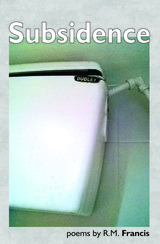
Featured Publication – Subsidence by R.M. Francis

Our featured publication for February is Subsidence by R.M. Francis, published by Smokestack Books.

The ground gives, the walls crack and our foundations are laid bare, revealing fragments of history, myth and memory we had forgotten once were ours. Subsidence is about the post-industrial Black Country landscape, where houses sink into old mines and the present collapses into the past beneath our feet. Written just before and after the 2016 Brexit referendum, these poems are love songs to the dialect and culture of the Black Country, odes to working-class communities, and laments for the unwanted and off-kilter.

A love letter spoken in his mother tongue, refusing to be a second language, a vernacular ripe with the heart and soul of everyday people. This is an observation of both strangers an’ kin, sometimes smashed glass of people’s lives reflecting a beautiful constellation under a Black Country sky.’ Roy McFarlane

A glorious musical score of Black Country dialect with all its complex tone colours and rhythms. Borderlands of class, the liminal aching space occupied by those who are not easily categorised are cracked open and witnessed.’ Roz Goddard

He is our Black Country guide to the relics, rituals, coping strategies of a defunct working class. Defiantly vernacular, written in dialect, we encounter the mythic, Germanic smith Wieland and his descendants in their haunts of pub, car park, footy pitch and wasteland, held captive and hamstrung by a tyranny of class and prejudice.’ Bob Beagrie
‘E grew the best runners in Bilbrook,

‘E grew the best runners in Bilbrook,
always ‘ad a grin an’ an ‘ow do, cock?
always ‘ad handshake
for stranger an’ kin
an’ e’d drive us mad with ‘is cantin’
‘e’d never leave anyone loney.

‘E grew the best runners in Bilbrook,
‘Stan’s Patch’ marked ‘is plot
an’ ‘e marked plots with poppies
for ‘is muckers who fell in Malaya,
an’ ‘e’d tell tall tales
of guardin’ the palace
an’ blartin’ with the Duke
about cheeky ales
down the Bag O’ Nails.

‘An sometimes
with a bowl-gut a scotch
you’d ‘ear ‘im singin’
Johnny Cash laments
in slurred baritones.

When Nan an’ Mom
went up the bridge
‘E tipped me two fingers
of whisky an’ said:
You know, our Rob,
me an’ ya Nan, we always
say good mornin’, every
mornin’, thass right, that is.

‘E grew the best runners in Bilbrook
an’ ‘e ‘ad a jab to go with left hook
an’ ‘e beat back death in the jungle
an’ ‘e beat back death in a truck crash
an’ I wish I could lay my knuckle
on that cruel, twisted curse
that steals minds before their time.
But I kip it locked in,
an’ lock in
on ‘ow even at the end
‘e’d force ‘is tired mouth to grin
at the sight and sound
of ‘is great grandkids.

Sleepin’ beasts

Skies mirror coal seams and slate of cinder smoke –
tethers grey birds to its oil slick,
cloaks wenches’ washing lines,
hanging out failed whites
for blokes on the box
who doh know how to clear
the cloud in their eyes.

Down on The Wrenner land is littered –
winds clip used cans through estates,
passed scorched out sofas weedy teens
use to toll the day.
This land –
nesting tumour in a cold parish.

Iss like our Tim keeps cantin’:
weem cut from ‘ere in all iss umber,
like the cut was cut from clay.
We ay nature’s sons,
just med of it, someway.
‘Cause weem cut that way,
weem cut away.

Down on The Wrenner air is soiled
with unwashed pets, cigarettes,
dried booze, pizza crust breath.
This air –
pricked silica leak of rotting cells.

Tim treds the towpath to ‘is ESA review,
over grit and sand ‘e used to alchemy to glass
but now just plays a part
in weathering muck.

They doh know
wass under theya –
our earth’s rotten
with trilobites.
Weem stompin’ on sleepin’ beasts.

Previously published in the Nine Arches Press anthology Spake

Herring Gulls of Gornal Wood

Territory echoes in a coop-caw chorus,
clattering terrace rows
as machinists break fasts,
hectic parents scrum passed
speckles of teenage barks,
baby squawks. The coop-caw rasps
in snare drum claps – a guttural kaa-kaa
over this morning’s scraps. Raptored beak –
yoked with blood spot – snaps to yodel leftovers,
snaps to strike at smugglers
trying the same game.

……………..Why am they called Seagulls, Mom,
………………when we ay by the sea?
……………..Should call ‘em Gornal Gulls.

The neighbour no one speaks to
wrestles through the dew
to the recycling bins,
pitched on the car park
where teens spit and swear
at the lack of new models –
‘E’s bin pickin’ on little Sammy,
‘Er’s bin pickin’ over glossy bones of celeb mags

the neighbour no one speaks to searches for plastic intimacy.

Soon, taupe spans
soar to another spot – do it all again.

Previously published in Raum and Eunoia Review

R. M. Francis is a lecturer in Creative and Professional Writing at the University of
Wolverhampton, where he also completed his PhD. He’s the author of five poetry pamphlet collections. His debut novel, Bella, was published by Wild Pressed Books and his collection of poems, Subsidence is out with Smokestack Books. In 2019 he was the inaugural David Bradshaw Writer in Residence at the University of Oxford and is currently the Poet in Residence for the Black Country Geological Society.

Subsidence is available to purchase from the Smokestack Books website.

Tied to the 90s – Ben Banyard

Tied to the 90s

She’s kept all her tapes, CD singles, scratched vinyl.
The t-shirts she bought at gigs at toilet venues
where sweat poured from the walls and tangled her hair.
Refuses MP3 players, iTunes, cloud content
which she cannot hoard, keep safe, archive.

She remembers personal stereos slowing to sludge
when the batteries wore out, cassettes unspooled, devoured 
by the mechanism, tape heads which muffled sound, 
had to be cleaned gently with a cotton bud.

It’s a small rented house in a town you don’t visit.
She has young kids, a son and daughter who share a room.
They know Oasis, Pulp, Manics, Ride, Neds,
Carter USM, Pop Will Eat Itself, The Wonder Stuff.

Know too that their mum draws strength from those bands,
comes alive when they ask her about those years;
there was a brief moment in the spring of 1997
when the world caught fire and possibility shone through.
She likes to stay there some days, doesn’t go in to work.

Ben Banyard lives in Portishead on the Severn Estuary. He has published two collections of poetry, Communing (Indigo Dreams, 2016) and We Are All Lucky (Indigo Dreams, 2018) with a third, Hi-Viz, due out from YAFFLE in Spring 2021. He blogs at https://benbanyard.wordpress.com

A retired Shipyard Draughtsman hears the Ghost-Pilot’s song – Bob Cooper

A retired Shipyard Draughtsman hears the Ghost-Pilot’s song

He stands, blueprints now memories, grips the rail tightly, sees
the current’s strength that forces brown water as mist solidifies

drifts downstream, to become self-fulfilling shapes of ships
longer than warehouses, masts tall as cranes at Cammell Laird’s

then hears a ghost-pilot sing as they pass the floodlit Three Graces
mentioning trade routes, merchandise, vessels’ names, their owners,

while the moon’s light gleams on their stones, long-dark windows,
shimmers on the river, reaches him. Watery-eyed he turns, walks

having heard in the breeze on the Mersey’s not-yet-dawn flow
laments that float over its surface. He sings their echoes.

Bob Cooper has had 7 pamphlets published – six of them winning pamphlet competitions. He’s also had two full length collections published, one by Arrowhead in 2002 then another with Pindrop in 2017 see:  http://www.pindroppress.com/books/Everyone%20Turns.html   He lives on the Wirral.

Propagation – Maeve McKenna

Propagation

They cluster inside spread-
eagled legs, hands bone
wings, faces pleading,

hinged

on palms. I know them,
these people, their
atrocious need,

soured

breath of last night’s lust.
Still willing in the morning,
I relent for a puce

cheek,

uprooted pubic hair. Or,
occasional understanding.
I adore the life in them, more

truly

than mine; chiselled
from marrow, a blood-infused
platelet. How they dine to fill

belly’s

on propagation. Oh! hero.
Oh! Lover. Oh, desire
from consequence —

unwill me.

Maeve McKenna lives in Sligo, Ireland. Her poetry has been placed in several international poetry competitions and published in Mslexia, The Haibun Journal, The Cormorant, Galway Review, Boyne Berries, Sonder Magazine, Skylight47 and widely online.

Last Sighting – Tim Dwyer

Last Sighting

……………………………………….For a friend

Now the age of grandfathers,
he hobbles to the dunes
for a last sighting of swallows
dipping close to the gritty strand.
They gather for the African migration.

Never much a dancer,
he sways with the pirouettes
as the swallows scoop
hidden nourishment from briny air.

Before they return in the Spring,
the bed becomes his camp.
His glance travels from the window
downhill to the lough.
Grey gulls and their shadows
cross the rooftops and the trees.

One day, the swallows
will fly up from the gritty strand,
careen outside his windowpane,
then circle back to the sea.

Tim Dwyer’s chapbook is Smithy Of Our Longings (Lapwing Publications). He will have poems in the upcoming issue of Cyphers, and in the Irish Poetry Chair Commemorative Anthology. He has recently moved from the U.S. to Bangor, County Down.

Flicks – Pen Kease

Flicks

We never believed it, not really. All
that Technicolor. Searing purple pinks
of jacaranda splashed on whitewashed walls,
speedboats peeling foam through turquoise ink.

We sniffed in the dark with bundled coats, sighed
with sore knees, steaming slightly from the rain.
Didn’t want our own grubby Wedgewood skies,
oily grey streets, black-flied runner beans on sticks.

We yearned blues, greens – intense as actors’ eyes,
salacious as a lover’s kiss. We took it all home,
that Glorious Technicolor, every dream and lie.
And it kept us warm. On the bus. With chips.

Pen Kease used to be a secondary school teacher but now writes poems instead. Pen has a recent MA in Writing from the University of Warwick and her poems have been published in a range of literary magazines and websites, including The Interpreter’s House, The Recusant, Militant Thistles, and Prole Magazine. She lives in South Oxfordshire with husband and cat, and cares for a scattered family as best she can

The day the ice came – Julia Webb

The day the ice came

you were pick-axe angry at the world
you came in from school and kicked the dog,
then spent hours in your room sobbing,
missing out on Blue Peter and The Wombles.
The afternoon had been sunny and warm
but by 6pm a chill was falling
and tiny snowflakes whirled against the glass.
When you put the dog out for her toilet
she ran straight back inside whimpering,
you warmed her paws by rubbing them
with mum’s old hair dye towel.
Mum felt sorry for you for once
and let you stay up to watch grown-up TV
until Dad returned from the pub,
a leering snowman, his breath on fire.

Julia Webb is a Norwich based poet/editor, she runs online and real-world poetry courses. She is a poetry editor for Lighthouse (a journal for new writing). She has two poetry collections with Nine Arches: ‘Bird Sisters’ (2016) and ‘Threat’ (2019).

And the curlews call – Niall Machin

And the curlews call

Outside
An almost imperceptible
Bristling
Tinselfies the grass
Heralding another frost –
……………that time when I lose people, I think
And the curlews call

Inside
It’s my watch
You sleep like a dormouse
Layers of time, friendships, family and pets
Weighing you down
…………and keeping you warm
In equal measure

David sleeps in the next room
Banished
With a cold
His head cold too
Against the adjoining wall
………….far away but
As close to you as possible

Eva is motionless on the couch
Whilst Beth makes
The requisite phone calls
In this way we sleepwalk
Round this familiar old house
…………..rubik cube like
One down, one along

When someone has touched so many lives
We defend our family right
To usher in death
Unilaterally
‘Bad weather always seems worse through a window’
…………..was one of your sayings
Railing at the storm clouds

Niall Machin lives in Bradford-on Avon and has recently had work published in Bath Magg. Find him on Twitter @NiallMachin1 

How do you split a washing machine down the middle? – Natalie Scott

How do you split a washing machine down the middle?

We’ve been told to divide items equally.
Fairly. Nothing about this seems fair.

Punching numbers on a calculator
works fine if we see the figures

not what they mean. Our equal halves
of the stock, or the shared life

we accumulated over twenty years?
We talk so readily of our ‘other half’

that we believe we can’t be whole
on our own. Some things just don’t split

down the middle. Apparently, we do.
But what about the toaster, the oven,

the kettle? We can take an axe to them.
Or not. Either way we get burned.

I feed sheets into its seething mouth.
Speechless. I watch them turn,

imagining a frothing fissure line
between your side and mine.

Natalie Scott is an internationally published poet and Creative Writing lecturer. Her latest award-winning collection Rare Birds – Voices of Holloway Prison, published by Valley Press on International Women’s Day, 2020, received ACE funding for a West End performance.

My mother, at sixty, tries her first oyster – Cheryl Pearson

My mother, at sixty, tries her first oyster

You eat with your eyes: it’s why you refuse
the grey rice I fry with shiitake, the copper-smelling
steak cooked rare. In Copenhagen, we walk for miles,
stopping for glasses of gold beer. The light swarms
on Nyhavn harbour, turns the water to fire. Mother,
you have the bones of a sparrow, a whale’s hunger.
It becomes the running gag on the trip –
how you pad the hours between meals with waffles,
sneak the fruit from our cocktail sticks. Our last afternoon,
sun-flushed, drunk, we order wine in a yellow courtyard.
It’s happy hour, the waiter says, would you like to try
our oysters? Your face sours. You wouldn’t, no,
but my sister and I each order four. You are sixty this year,
you have always wanted to visit this city. You never thought
you would get on a plane, you didn’t know how pretty it would be:
the blossoms and palaces in the parks, the gold domes against
blue sky. It’s good to try new things, you say, and joking,
my sister offers up an oyster from her plate, trembling lightly
in its socket, wet, grey-white, and mucal. You hesitate, then take it
as we watch, amazed. You take the salt, a spoon of onion, finish
with a twist of lemon. This is an event – more of a surprise
than the March heat, the swan-shaped boats. We train our phones
to film your face. You won’t do it. Your throat works. And then
you take a breath, your whole face screws, and quick as anything
you suck it in, that well of slime, you grimace, chew, then gulp
it back. We cheer and clink our glasses; Actually, you say,
that wasn’t bad! This, all your life, is how it’s been: you’ve stayed
in the lines and away from edges, raw fish, fireworks, roller-coasters.
Now you are sixty, still risk-averse, but trying your feathers.
It’s joyous to watch: our cautious mother choosing fuck-it over fear.

Cheryl Pearson is the author of ‘Oysterlight’ (Pindrop Press) and Menagerie’ (The Emma Press). Her poems have appeared or are forthcoming in publications including The Guardian, Mslexia, and The Moth, and she has twice been nominated for a Pushcart Prize.